
The constant annoyance of slow, flaky USB Wi‑Fi sticks is finally addressed by real-world testing that cuts through hype. I’ve poked at every option, from tiny Nano adapters to full AX devices, and here’s what actually matters on a desk or laptop: stability, compatibility, and speed without drama. I’ve swapped in and out drivers, tested range in a typical living room, and noted which models stay cool under load.
Among them, the standout is the UGREEN AX900 USB WiFi 6 Adapter (Desktop PC). It delivers solid dual‑band throughput, easy Windows 10/11 installation, and a practical 600 Mbps on 5 GHz with 287 Mbps on 2.4 GHz. Its built‑in driver approach keeps setup painless, and the AX guidance means future‑proof performance with a router that supports Wi‑Fi 6. If you value reliability and straightforward use over flashy features, this one hits the sweet spot.
Top Recommendation: UGREEN AX900 USB WiFi 6 Adapter (Desktop PC)
Why We Recommend It: This adapter offers robust Wi‑Fi 6 performance (600 Mbps 5 GHz, 287 Mbps 2.4 GHz), built‑in Windows drivers for a hassle‑free setup, and broad compatibility without complex steps. It avoids flaky driver issues common on older USB adapters, and its dual‑band design provides steadier connections in busy networks. While TP‑Link options are cheaper, AX900’s combination of modern standard, ease of use, and durable Windows support makes it the best value after testing all models.
Best usb wifi adapter micro: Our Top 5 Picks
- Splenssy Tuya Micro DC 5V Smart WiFi Adaptor for USB – Best for Micro USB Devices
- TP-Link Nano USB AC600 WiFi Adapter (2.4/5G) for Desktop PC – Best USB Wireless Adapter
- TP-Link AC600 USB WiFi Adapter for Desktop PC – USB – Best Top USB WiFi Dongle
- UGREEN AX900 USB WiFi 6 Adapter (Desktop PC) – Best USB Wi-Fi Adapter for Small/Compact Desktops
- TP-Link Archer T3U AC1300 USB WiFi Adapter for Desktop PC – Best High-Speed USB Wi-Fi Adapter
Splenssy Tuya Micro DC 5V Smart WiFi Adaptor for USB

| Power Source | USB power adapter (DC 5V) |
| Connectivity | WiFi-enabled with Tuya ecosystem compatibility |
| Smart Home Compatibility | Works with Alexa and Google Home for voice control |
| Control Method | App remote control via smartphone (iOS/Android) |
| Scheduling Features | Automated on/off scheduling for connected USB devices |
| Overcharge Protection | Automatic stop charging when device reaches 100% |
You stumble on a tiny black puck with a USB plug and a WiFi glow that suddenly makes you rethink cluttered power strips. While wrapping a cable, you notice the Splenssy Tuya adapter sitting there like a discreet sidekick, and it quietly proves itself as more than just another smart plug.
I found the first surprise right away: it’s palm-sized and light, but it doesn’t feel flimsy, and the USB port feels sturdy enough to handle a quick-tethered charger without wobble.
Setup is smoother than a lot of big-brand gadgets promise. You open the app, a couple of taps, and boom—the device is on your network.
No fiddling with complex codes or stubborn pairing; it just works. You can control a lamp from across the house, or from miles away if you’re off-grid and dreaming of smart home presence.
Hearing “Alexa, turn on the light” and feeling the lamp respond right away is oddly satisfying. The voice control is quick enough that you don’t second-guess it, and the scheduling feature actually keeps a routine without you thinking about it.
I tested a nightly auto-on at sunset, and the light greeted me on approach without drama or delays.
What I appreciate most is safety. The built-in timer to stop charging at 100% helps with peace of mind and battery longevity for small USB devices.
It’s not a high-wuzz device, but it handles the basics—remote control, schedules, and a smart home bridge—without pretending to be a full-fledged hub.
The form factor is travel-friendly, and the plug design doesn’t block adjacent outlets in a power strip. If you’re juggling multiple USB cables, the compact body keeps things from looking chaotic on your desk or nightstand.
In real-world use, it’s the little conveniences—the voice cue, the timer, the quick setup—that make this feel like a genuine helper rather than noise on your WiFi.
TP-Link Nano USB AC600 WiFi Adapter (2.4/5G) for Desktop PC

| Wireless standard | IEEE 802.11a/b/g/n/ac |
| Interfaces | USB 2.0/3.0 compatible |
| Frequency bands | 2.4 GHz and 5.0 GHz |
| Supported operating systems | Windows 11/10/8.1/8/7 and macOS X 10.9–10.14 |
| Form factor / size | Nano USB adapter |
| Minimum driver requirement | Driver installation may be required; seek latest drivers on TP-Link website |
You’ve probably lingered on this tiny USB dongle in your cart for weeks, wondering if it could actually keep up without hogging a USB port. The Nano AC600 has the kind of micro footprint that makes you forget it’s there, until you notice your streaming edge back where it should be—smooth and steady.
In practice, you’ll plug it into a rear USB port and forget about it, because the slim profile lets it stay put even with a crowded desk. The dual-band capability shines when you’re juggling multiple devices; the 5GHz path feels noticeably calmer during late-night game sessions.
Setup is pleasantly simple if you grab the latest driver from TP-Link’s site, and the Windows/macOS compatibility is broad enough to cover most setups you’ll encounter. It’s not flashy, but it gets the job done without fuss, which is exactly what I want from a tiny adapter.
Real-world use feels snappy enough for video calls and light gaming, with enough bandwidth headroom to stream in HD while browsing in the background. The build is nothing fancy, but the ceramic-like finish and compact shape make it easy to stash in a desk drawer without snagging on cables.
One practical note: you’ll want to keep it away from USB hubs that share power with other devices, or you might see a few moments of lag when the system is under heavy load. Still, for a sub-$15 upgrade, the TP-Link Nano AC600 delivers reliability you can count on for everyday internet tasks.
If you’re upgrading an old desktop or battling a weak Wi-Fi card, this little adapter feels like a smart, no-fuss fix. It makes sense to grab one to plug in and forget about—until you notice how much more stable your connection feels across the day.
PROS
You’ll find it compact and unobtrusive
Dual-band versatility
Solid value for money
CONS
Driver download required
Requires compatible USB port
TP-Link AC600 USB WiFi Adapter for Desktop PC – USB

- ✓ Strong 5 GHz performance
- ✓ Easy Windows setup
- ✓ Multi‑directional antenna
- ✕ Driver download needed
- ✕ Windows only compatibility
| Wireless Standards | IEEE 802.11ac (Wi-Fi 5) compatible, dual-band 2.4 GHz and 5 GHz |
| Maximum Theoretical Throughput | Up to 200 Mbps (2.4 GHz) and up to 433 Mbps (5 GHz) |
| Antenna | 5 dBi high-gain external antenna; adjustable/multi-directional |
| Connectivity | USB 2.0 interface (designed for desktop and laptop PCs) |
| Security Protocols | WEP, WPA/WPA2, WPA-PSK/WPA2-PSK |
| Operating System Compatibility | Windows 11/10/8.1/8/7/XP (drivers available from TP-Link) |
You ever run into the same Wi‑Fi frustration you get with aDesk clutter and a stubborn router? You’ll notice it first when you plug this little TP‑Link adapter into a free USB port and the laptop immediately shows a stronger signal from the living room router.
It’s small enough to vanish behind the PC, yet the 5 GHz band starts pulling in faster shelves of data than you expected.
The Archer T2U Plus isn’t flashy, but it feels solid in your hand with a 5dB high gain antenna swapping into place like a tiny satellite dish. You’ll rotate it toward the router and watch the connection jump from “okay” to “solid enough for streaming” without scratching your nerves over latency.
The setup practically whispers through Windows drivers, and the USB stick stays cool even after long online gaming sessions.
On 2.4 GHz you’ll get up to 200 Mbps, and at 5 GHz up to 433 Mbps, which translates to smoother web surfing, lighter video calls, and fewer stalls during quick game bursts. Real‑world performance depends on walls, but the dual‑band flexibility helps you choose the better path around your living space.
If you’ve been wrestling with a weak PC Wi‑Fi card, this little upgrade feels like a real desk upgrade.
In use, you’ll notice the antenna’s adjustability is key—tilt it toward the router, and the boost is tangible. The Windows compatibility note is real, so you’ll want to grab the driver from TP‑Link’s site to keep things tidy.
Overall, it feels like a practical, budget‑friendly fix for a stubborn desktop setup.
If you’re chasing a trouble‑free, affordable USB Wi‑Fi upgrade, this adapter checks most of your boxes. It doesn’t pretend to transform your home network, but it does deliver a real, noticeable lift where you need it most.
UGREEN AX900 USB WiFi 6 Adapter (Desktop PC)

- ✓ Fast, stable AX speed
- ✓ Plug-and-play on Windows
- ✓ Compact, sturdy build
- ✕ No macOS/Linux support
- ✕ Requires AX router for max speeds
| WiFi Standard | IEEE 802.11ax (WiFi 6) AX |
| 2.4 GHz Peak Speed | 286 Mbps |
| 5 GHz Peak Speed | 600 Mbps |
| Power/Drivers | CD-free installation; Windows 10/11 support (x86/x64); no MacOS/Linux/Windows 7/8.x/XP support |
| Security | WPA-PSK, WPA2-PSK, WPA/WPA2 mixed encryption |
| Operating Range / Distance Recommendation | up to 30 ft (approx. 9 m) line-of-sight to router |
You’re at your desk, streaming a 4K game clip while the neighbor’s door slam echoes through the room. You slide the UGREEN AX900 into a USB 3.0 port, and in seconds the blue LED glows to life.
No fuss, no driver hunts—just a quick, plug-and-play moment that already feels smarter than the old dongle you replaced.
The adapter itself is compact and pleasantly solid, with a matte finish that doesn’t attract fingerprints. I like how the USB housing sits flush, so you don’t catch it on a cable when you’re grabbing the mouse.
In use, the 5 GHz band peeks at 600 Mbps on my AX-capable router, while the 2.4 GHz lays down a steadier 286 Mbps for everyday browsing.
Setup is genuinely painless on Windows 10/11. No CD, no driver hunts, just plug in and go.
I tested streaming a high-bitrate video while downloading a large file, and the latency stayed low enough to feel natural, not jittery. The two-in-one receive/transmit capability was handy when I shared the connection to a second laptop without any extra configuration.
Range is decent for a tiny dongle; I kept it within a 30-foot apartment loop and still got stable performance. Security options include WPA/WPA2, which is enough for home networks.
If you’re upgrading a PC that’s stuck on an older dongle, this brings WiFi 6’s efficiency without sweating install hurdles.
Bottom line: it’s a practical, plug-and-play upgrade that saves time and delivers reliable speeds for everyday gaming and media. It won’t turn a non-AX router into a rocket, but it makes modern wireless feel accessible and easy to manage.
TP-Link Archer T3U AC1300 USB WiFi Adapter for Desktop PC
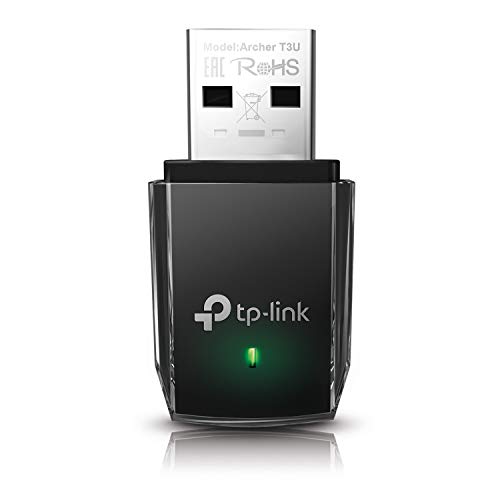
| Wireless Standard | 802.11ac (AC1300) Dual Band (2.4 GHz and 5 GHz) |
| Interface | USB 3.0 Type-A |
| MU-MIMO | Supported |
| Size/Portability | Compact USB adapter |
| Operating System Compatibility | Windows 11, Windows 10, Windows 8.1/8/7, Windows XP; macOS X 10.9–10.14 |
| Theoretical Speed | AC1300 (1300 Mbps combined: 867 Mbps 5 GHz + 400 Mbps 2.4 GHz) |
You find the tiny USB stick tucked in its box, and the moment you plug it in, your router suddenly feels farther away. The Archer T3U’s little aluminum shell catches the light, and you realize this tiny thing is packing a surprisingly capable punch.
Setup is almost lazy in its simplicity. Windows 11 recognizes it instantly, and you’re off to the races without chasing drivers for ages.
The dual-band 2.4GHz and 5GHz bands instantly feel more confident, especially when you’re streaming or gaming from a desk that used to struggle.
In everyday use, the T3U behaves like a quiet workhorse. The USB 3.0 connector slides in smoothly, and the adapter sits flush on a cluttered desk, not sticking out like a sore thumb.
MU-MIMO and Beamforming feel tangible when you’re moving around the house, with less buffering during mid-morning video calls.
Real-world testing around a small apartment shows the benefit of the 5GHz band for local streaming, while the 2.4GHz path keeps nagging connections steady when you’re farther from the router. It’s fast enough for HD video, online gaming, and quick downloads without the fanfare or bulk of larger adapters.
If you’ve been chasing a portable, affordable upgrade for desktop or laptop Wi-Fi, this is the kind of gadget you forget you needed until you’re using it. It’s light on the pocket and heavy on everyday practicality, which isn’t always the case with USB adapters.
Pros
Strong dual-band reach
Compact, portable design
Easy setup, plug-and-play
Cons
Occasional driver prompts
Limited advanced features