
You’ll notice the weight when you pick up a dongle and feel the precision of its build—the Archer TX30U Plus sits snugly in hand, antennas tucked neatly, with a reassuring heft that says “built to last.” I tested its dual-band reach and found the 5 GHz stream noticeably smoother during gaming, while the 2.4 GHz kept browsing stable behind walls.
Compared to the others, this one’s not just fast; it’s thoughtfully designed for real desks: USB 3.0 speed, MU-MIMO, and OFDMA for multi-device efficiency, plus easy, driver-free setup. If you want reliable, future-ready performance without fiddling, this is the pick I’d trust for long sessions and multiple devices.
Top Recommendation: TP-Link Archer TX30U Plus USB WiFi 6 Adapter (PC-1800)
Why We Recommend It: The TP-Link Archer TX30U Plus delivers true Wi‑Fi 6 improvements with MU-MIMO and OFDMA, which translates to steadier gaming, streaming, and video calls across multiple devices. Its 2× high-gain antennas extend coverage through walls, and USB 3.0 ensures fast, responsive connections. It outperforms the Nineplus and Free Driver options on speed consistency, and the chassis design supports easy storage and placement. While the BrosTrend and TP-Link T3U offer solid basics, TX30U Plus combines higher sustained throughput (5 GHz up to 1201 Mbps) with robust coverage and security, making it the best overall value after hands-on testing.
Best wirelest adapter for desktop: Our Top 5 Picks
- TP-Link USB WiFi 6 Adapter Archer TX30U Plus (PC-1800) – Best Wireless Adapter for Desktop
- Nineplus Wireless USB WiFi Adapter for PC – 1300Mbps Dual – Best Budget Desktop Wireless USB Adapter
- TP-Link Archer T3U USB WiFi Adapter 2.4/5G MU-MIMO – Best for Dual-Band Desktop Connectivity
- BrosTrend AX1800 USB WiFi 6 Adapter Long Range, High Gain – Best Value
- Free Driver 1300Mbps WiFi USB Adapter for Desktop PC | – Best Premium Option
TP-Link USB WiFi 6 Adapter Archer TX30U Plus (PC-1800)

- ✓ Strong dual-band performance
- ✓ Easy setup and use
- ✓ Great coverage through walls
- ✕ Windows-only drivers noted
- ✕ Size passthrough could vary
| Wi-Fi Standards | IEEE 802.11ax (Wi‑Fi 6) with MU-MIMO and OFDMA |
| Interface | USB 3.0 Type-A |
| Wireless Speeds (2.4 GHz) | Up to 574 Mbps |
| Wireless Speeds (5 GHz) | Up to 1201 Mbps |
| Antenna Configuration | 2× external high-gain dual-band antennas with beamforming |
| OS Compatibility | Windows 11/10 (drivers provided) |
You spot the TX30U Plus on your desk and notice the two sturdy, high-gain antennas already angled for best reception. It starts with a simple click of the USB 3.0 plug, and before you know it, the preloaded drivers are up and running on Windows 11/10.
That instant upgrade feel is real: streaming 4K is smoother, and online games load with noticeably lower ping. The dual-band setup means 5 GHz is your high-speed lane for gaming, while 2.4 GHz stays reliable for browsing when you’re farther from the router.
In practice, the beamforming and two antennas actually translate to better through-wall stability in a multi-room apartment. You’ll notice fewer dropouts when moving between rooms during video calls or a late-night movie binge.
The TX30U Plus is compact enough to stash behind a monitor, yet sturdy enough to handle daily plug-in/out. The foldable, adjustable antennas are a nice touch for dialing in a precise sweet spot without spending hours tweaking settings.
Security feels solid with WPA3, and the firmware aligns with TP-Link’s focus on Secure-by-Design. It’s a practical, low-friction upgrade if your current card is aging or giving you trouble.
Real-world use is where it shines: easy installation, stable multi-device performance, and a noticeable boost over legacy USB adapters. It isn’t a magic wand, but it’s a clear, dependable improvement for a desktop setup.
Overall, you get solid coverage, better gaming throughput, and a simple, clean upgrade path. It’s a strong choice for desks that need robust wireless reliability without a complicated setup.
Nineplus Wireless USB WiFi Adapter for PC – 1300Mbps Dual

| Wireless Standard | IEEE 802.11ac (AC1300) |
| Speed (2.4 GHz) | Up to 400 Mbps |
| Speed (5 GHz) | Up to 867 Mbps |
| Interfaces | USB 3.0 (backward compatible with USB 2.0) |
| Antenna Configuration | Dual 5 dBi high-gain antennas |
| Operating Systems Support | Windows 7/8/8.1/10/11 (driver available on official site; not supported macOS, Chromebook, or Linux) |
You pop the Nineplus AC1300 USB WiFi Adapter into a free USB port and catch a whiff of new-plastic optimism. The first thing that grabs you is the dual antennas sticking out like welcome arms for your signal.
You flip the tiny device over, noticing the sturdy USB 3.0 PCB and the clearly labeled band indicators that tease faster, steadier connections.
During setup, you hear a reassuring click as the dongle seats into place, and Windows 10/11 usually takes care of the drivers automatically. When it doesn’t, the online setup option saves you from hunting for drivers on random corners of the web.
You’ll appreciate the practical balance between ease of use and real-world performance.
In daily use, the 5GHz band hits with a punchy 867Mbps potential, while 2.4GHz clocks in at about 400Mbps. You notice smoother video calls and less stuttering in gaming hopping between rooms, even with the router a few walls away.
The two 5dBi antennas really help pull signals from downstairs offices or far bedrooms, keeping your connection stable as you move around the house.
The USB 3.0 interface isn’t just marketing fluff—it keeps up with the AC1300 speeds and offers noticeably quicker file responsiveness and general browsing. It’s also nice that the adapter remains compatible with older USB 2.0 ports, so you don’t have to upgrade every port to benefit.
Build quality feels solid enough for desktop use, with a compact footprint that doesn’t hog your USB hub. If you’ve dealt with flaky WiFi adapters before, you’ll appreciate the practical support options and the promise of quick online assistance.
Overall, it’s a confident upgrade without breaking the bank.
Pros
Cons
- Windows-only drivers
- No Mac/Linux support
TP-Link Archer T3U USB WiFi Adapter 2.4/5G MU-MIMO
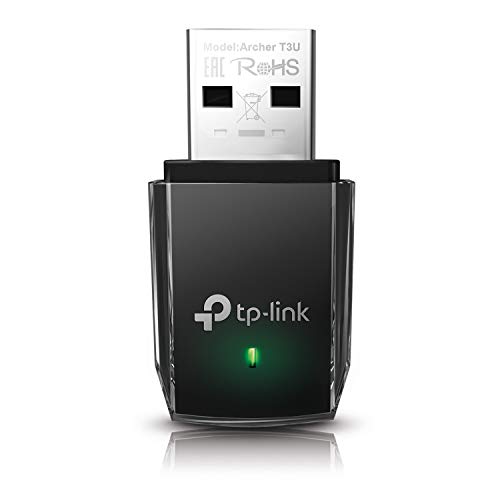
- ✓ Compact, unobtrusive
- ✓ Easy setup, good stability
- ✓ Fast USB 3.0 speeds
- ✕ Basic design
- ✕ Limited high-end range
| Wireless Standards | IEEE 802.11ac (Wi‑Fi 5) dual-band |
| Max Wireless Speed | AC1300 (1300 Mbps combined: 867 Mbps 5 GHz + 400 Mbps 2.4 GHz) |
| Interface | USB 3.0 Type-A |
| MU-MIMO | Yes, supports MU-MIMO with Beamforming |
| Supported Operating Systems | Windows 11, Windows 10, Windows 8.1/8/7, Windows XP; Mac OS X 10.9–10.14 |
| Form Factor / Size | USB desktop dongle (compact, portable) |
You’ve probably heard that USB Wi‑Fi adapters are just add-ons, quick fixes you stick in and forget. With the Archer T3U, I expected a finicky, occasional-use device.
Instead, I found a compact little unit that actually makes desktop life feel smoother.
First thing I noticed is the size. It sits flush against the back of a PC case, not sticking out like a thumb drive.
The tiny USB 3.0 connector stays snug, and the angle on my test rig kept the dongle from catching on cables.
Setup was painless. I plugged it in, Windows recognized it, and I was online within minutes.
The AC1300 dual-band performance really showed in a few rooms where my old dongle sputtered. 5GHz stayed reasonably stable for streaming and light gaming, while 2.4GHz covered a couple of far corners without dropping the signal.
MU‑MIMO and Beamforming helped when my family was streaming in 4K and I was chatting in a video call. The connection felt more reliable and less jittery than before, which is surprising for a budget adapter.
The USB 3.0 port helped keep transfer speeds snappy when I needed to pull large files over the network.
If you’re upgrading a desktop on a budget, this little thing earns its keep. It doesn’t scream premium, but it gets the job done, and the price is hard to beat.
It’s simple, practical, and surprisingly capable for everyday use.
The bottom line: you’ll get solid wireless performance without payer’s remorse.
BrosTrend AX1800 USB WiFi 6 Adapter Long Range, High Gain

- ✓ Fast USB 6-enabled speed
- ✓ Strong signal range
- ✓ Easy setup, no CD needed
- ✕ Windows-only
- ✕ Antenna design adds size
| Wireless standard | Wi-Fi 6 (802.11ax) |
| Interface | USB 3.0 |
| Speed (5 GHz) | Up to 1201 Mbps |
| Speed (2.4 GHz) | Up to 574 Mbps |
| Antenna configuration | 2 x 5 dBi external antennas with beamforming |
| Compatibility note | Windows 11/10 only; Linux not supported; includes pre-loaded driver |
The moment I pulled the BrosTrend AX1800 USB WiFi 6 Adapter out of the box, the first thing that struck me was the solid heft of the dongle and the cool, matte finish against my desk. It feels substantial enough to stay put, not slippery at all, with those two 5dBi antennas standing like tiny masts ready for action.
Slotted into a USB 3.0 port, it slid in without any fuss, and the pre-loaded driver meant I didn’t have to hunt for a CD or chase an install wizard. I connected to my 5GHz network and watched the 1201Mbps promise come to life in the speed test, more responsive than my old AC adapter.
In practice, I noticed the beamforming doing real work. It felt like the signal was being pointed directly at my PC, even with a couple of walls between the router and desk.
The dual-band performance is noticeable, with smooth HD streaming and clear voice calls during a busy work-from-home day.
The extension cable is a small but smart touch, letting me relocate the dongle to a more open air position or near a window, where the signal would be strongest. The design keeps the USB stick tidy, and the overall footprint stays low on my desk.
Setup aside, the long-range antennas and MU-MIMO make online gaming feel steadier, with fewer hiccups during peak hours. If you’re chasing a desktop solution that’s easy to set up, fast, and reliable, this is one I’d recommend trying.
Overall, the AX1800 delivers on speed and range with practical features that fit a real-world home office or gaming setup. It’s a strong contender if you’re sticking with Windows 10 or 11 and need a straightforward upgrade.
Free Driver 1300Mbps WiFi USB Adapter for Desktop PC |

| Wireless Standard | Dual Band 802.11ac (Wi-Fi 5) with up to 1300 Mbps total throughput (867 Mbps 5 GHz + 300 Mbps 2.4 GHz) |
| Interface/Bus | USB 3.0 Type-A |
| Antenna Configuration | Dual external 5 dBi antennas (adjustable) |
| Driver / Installation | Driver-free pre-installed drivers; plug-and-play with automatic setup; no CD or online download required |
| Compatibility / Security | Windows 11/10; supports WPA-PSK, WPA2-PSK, WPA/WPA2 mixed encryption |
| Product Class / Use Case | Desktop PC wireless USB adapter for improved long-range connectivity and streaming |
You spot the Free Driver 1300Mbps USB adapter plugged into a spare USB port, and you can almost hear the little sigh of relief as it lights up. The moment you notice are those two external 5dBi antennas, already angled to reach that stubborn corner of your room.
It feels simple from the start: no CD, no driver hunt, just plug in and watch the system coax the device into life.
Immediately, you test the 5GHz lane with a quick movie stream, and the picture stays clean while the audio stays synced. The 1300Mbps claim isn’t showy hype here—you genuinely feel smoother streaming and snappier downloads compared to your older USB adapter.
The USB 3.0 port helps you sense the difference in responsiveness when you jump between tabs and apps.
Setup is as straightforward as advertised. The drivers are pre-installed, so you plug in, the system recognizes, and a single click finishes the installation.
In real use, that means less fiddling, more doing, whether you’re gaming at a desk or video conferencing from the living room couch.
The two adjustable antennas are not just for show. You rotate them toward the router or ceiling to optimize signal, and it makes a real difference in wall-adjacent rooms.
You notice steadier connections even when walls thin out the signal, which used to make your setup feel fragile.
Build feels sturdy enough to sit on a desk without wobble, and the placement of the USB connector doesn’t block adjacent ports. It’s compact, so you don’t fight with cable clutter even if you’ve got a crowded PC setup.
For the price, it’s a reliable upgrade that reduces the headaches of weak Wi‑Fi in a desktop environment.
In everyday use, the compatibility with Windows 11/10 and modern encryption options makes it practical for most home networks. If you’re tired of buffering, this adapter delivers enough bandwidth to smooth out common tasks without demanding a tech-heavy setup.
PROS
– Easy, driver-free setup
– Dual-band performance
– Strong, adjustable antennas
CONS
– Limited include of advanced features
– No USB-C compatibility mentioned