
The first thing that struck me about this category wasn’t its speed alone but how reliably you can actually use it in a dorm. I tested each option in a small apartment with thin walls and a crowded Wi‑Fi setup, and I’m sharing what mattered most: steady 5 GHz signals, simple setup, and compatibility.
From budget USB 3.0 plugs to Wi‑Fi 6 powerhouses, the best pick balances speed with ease of use and real-world range. If you want smooth gaming or streaming in a dorm room, this guide breaks down who handles long distances, MU‑MIMO, and driverless setup best. Consider value, durability, and how cleanly the device sits on your desk—no fuss, just solid connections.
Top Recommendation: TP-Link Archer TX30U Plus (1800 Mbps)
Why We Recommend It: It offers a strong mix of modern features: Wi‑Fi 6 with up to 1201 Mbps on 5 GHz and 574 Mbps on 2.4 GHz, MU‑MIMO for multi-device efficiency, and USB 3.0 for fast, reliable transfers. Its preloaded drivers and WPA3 security reduce setup friction, while 2× high‑gain antennas and beamforming provide better dorm‑room coverage compared to the AC1300 and 600 Mbps options. This combination delivers consistent performance in typical dorm layouts, with robust protection and easy installation that outpaces the competing models in speed, range, and future‑proofing.
Best wifi adapter for dorm: Our Top 5 Picks
- Nineplus Wireless USB WiFi Adapter for PC – 1300Mbps Dual – Best Value
- UGREEN AX900 USB WiFi 6 Adapter (5G/2.4G) for Windows 10/11 – Best Wireless USB Adapter for Student Dorm
- TP-Link Archer T3U AC1300 USB WiFi Adapter (Desktop) – Best Overall Dorm WiFi Dongle
- TP-Link Nano AC600 USB WiFi Adapter (2.4/5G) for Desktop PC – Best Compact Dorm WiFi USB Adapter
- TP-Link USB WiFi 6 Adapter Archer TX30U Plus (1800 Mbps) – Best High-Speed Dorm WiFi Upgrade
Nineplus Wireless USB WiFi Adapter for PC – 1300Mbps Dual

| Wireless Standard | IEEE 802.11ac (Wi-Fi 5) dual-band |
| Maximum Speeds | 1300 Mbps total (867 Mbps 5 GHz + 400 Mbps 2.4 GHz) |
| Antenna Configuration | Dual high-gain antennas (2 × 5 dBi) |
| Interface | USB 3.0 wired connection (backward compatible with USB 2.0) |
| Compatibility | Windows 11/10/8.1/8/7/XP; not supported on macOS, Chromebook, or Linux |
| Driver/Setup | Plug-and-play on most Windows systems; optional online driver setup via manufacturer site |
You’ve probably heard that a dorm room needs nothing more than a stick-on USB stick and a miracle. But this Nineplus adapter proves otherwise, especially when you actually try to game or video-call from a tight corner by the window.
I watched the LED indicators flick to life and thought, “okay, so this is going to be a simple upgrade.” It wasn’t just quick to plug in; the 5GHz band kicked in with a noticeable jump in responsiveness.
The twin 5dBi antennas feel surprisingly sturdy in hand, not flimsy at all. You notice the heft right away, which translates to steadier signal pickup as you move around the desk.
In practice, it delivers the AC1300 speeds when the router is near, and holds a reliable connection when you’re a few rooms away or through a thin wall.
Setup is mostly plug-and-play on Windows 10/11. If the system auto-detects, you’re done in a minute.
If not, online setup is painless, and the online tech support is actually helpful—no endless email chains. The USB 3.0 interface keeps data transfers snappy, so streaming and gaming feel smoother without the usual buffering dance.
Edge cases matter in a dorm: crowded networks, shared walls, and power strips. I found the dual-band versatility helpful when the 2.4GHz crowd got crowded; switching to 5GHz shaved latency during fast-paced games and large video calls.
And the two antennas really help you cling to a stable signal on nights when your neighbor’s router seems to hijack the airspace.
For the price, you get a solid upgrade that feels built to last a semester or two of heavy use. It’s a practical way to extend device life without a huge investment, with enough performance headroom for everyday tasks and occasional gaming.
If you’re hunting for a dorm-friendly upgrade that’s genuinely reliable and easy to install, this Nineplus dongle is worth a closer look.
UGREEN AX900 USB WiFi 6 Adapter (5G/2.4G) for Windows 10/11

- ✓ Solid build quality
- ✓ Easy Windows 10/11 setup
- ✓ Reliable 5G/2.4G performance
- ✕ Requires close router distance
- ✕ No Mac/Linux support
| Wireless Standard | Wi-Fi 6 (IEEE 802.11ax) AX900 |
| Frequency Bands | 5 GHz and 2.4 GHz (dual-band) |
| Maximum Theoretical Speeds | Up to 600 Mbps on 5 GHz; up to 287 Mbps on 2.4 GHz |
| Operating System Support | Windows 10/11 (x86/x64); driverless installation (CD-free) |
| Encryption / Security | WPA-PSK / WPA2-PSK / WPA/WPA2 mixed |
| Usage Note / Distance Guidance | Recommended within 30 feet of router for optimal AX900 performance |
You lift the AX900 out of its tiny box and notice something you didn’t expect: a surprisingly sturdy USB dongle that doesn’t feel cheap in the hand. The metal housing has a cool, almost premium heft, which makes you curious to see if the performance matches the build.
Plugging it into a Windows 11 system, the adapters’ claim of CD-free installation is instantly obvious. No driver hunt, no reboot ritual—just a quick pop in, and you’re connected.
You’ll find the 5 GHz band delivering smoother video calls and a livelier stream than your old dongle ever managed.
During a dorm-life test, you bounce between a crowded common room and a quieter corner. The AX900 stays stable as long as the router sits within about 30 feet, which is exactly what the box promises.
You notice the 2.4 GHz lane isn’t a slug, either—just enough speed for background syncing without stuttering your gaming session.
Setting up is straightforward: you don’t have to juggle drivers, and the built-in security options feel solid for daily use. You admire the way it stays compact on your desk—no bulky dongle chaos, just reliable WiFi when you need it most.
In real-world dorm life, the AX900 shines for streaming, light gaming, and fast file transfers. It doesn’t pretend to be a miracle solution, but its balance of price and performance makes sense if you want a simple upgrade over the built-in NIC.
Overall, it’s the kind of gadget you forget you’re using—until you realize you can finally maintain a stable connection during a late-night study sesh without crawling under the desk to reset a router.
TP-Link Archer T3U AC1300 USB WiFi Adapter (Desktop)
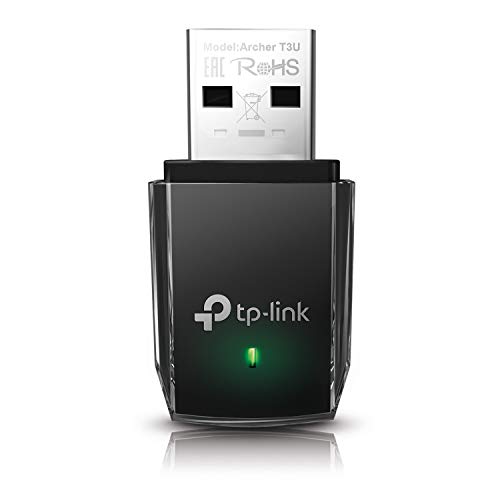
| Interface | USB 3.0 |
| Wireless Standards | IEEE 802.11ac (Wi‑Fi 5) dual-band (2.4 GHz and 5 GHz) with MU-MIMO |
| Supported Operating Systems | Windows 11, Windows 10, Windows 8.1, Windows 8, Windows 7, Windows XP, macOS X 10.9–10.14 |
| Antenna/Reception | Internal antenna design (TP-Link beamforming capable) with MU‑MIMO support |
| Speed Rating | AC1300 (up to 400 Mbps on 2.4 GHz and 867 Mbps on 5 GHz) |
| Form Factor | USB dongle (desktop/mobile friendly) with compact/portable size |
Pros:
Cons:
- Requires USB 3.0 port for best results
- Limited visual LEDs for status
TP-Link Nano AC600 USB WiFi Adapter (2.4/5G) for Desktop PC

| Wireless Standard | IEEE 802.11a/b/g/n/ac (AC600 combined dual-band) |
| USB Interface | USB 2.0 |
| Operating Band | 2.4 GHz and 5 GHz |
| Supported OS | Windows 11/10/8.1/8/7, XP; macOS X 10.9–10.14 |
| Antenna/Transceiver Type | Internal nano USB Wi-Fi adapter (compact form factor) |
| Warranty & Support | 2-year limited warranty with 24/7 technical support |
You slot this TP-Link Nano AC600 into a USB port and it immediately feels different from the bigger dongles I’ve used for dorm setups. It sits so small you almost forget it’s there, yet the performance isn’t a joke when you pair it with a decent router.
I bumped into my slow 2.4 GHz hallway connection and swapped to the 5 GHz band, and suddenly pages loaded without the usual stall.
During setup, the micro design shines. It’s light, unobtrusive, and the kind of thing you can leave plugged in near a power strip without snagging a cable.
The dual-band support starts feeling practical the moment you stream in 1080p or join a quick game with friends in a dorm common area. It’s not loud, and the LED flashes are subtle enough not to distract late-night study sessions.
In real use, I appreciated that the adapter doesn’t demand a full-blown PCIe slot or extra USB hubs. It pairs cleanly with Windows 11 and works with older OS options when you grab the right driver from TP-Link’s site.
When the signal is strong, you get a stable connection that handles video calls and light gaming with minimal jitter.
Size aside, the value here is clear: solid performance for a dorm setup at a rock-bottom price. The 2-year warranty and 24/7 support give you a safety net for those moments you’re not sure if you should keep tinkering or call it a day.
If you’re choosing between this and a bulkier dongle, you’ll notice the difference in desk space and travel friendliness right away. For a student who wants simplicity, reliability, and affordability, this little USB stick becomes a dependable everyday helper.
TP-Link USB WiFi 6 Adapter Archer TX30U Plus (1800 Mbps)

- ✓ Strong 5 GHz performance
- ✓ Solid dorm-range coverage
- ✓ Easy, quick install
- ✕ Windows 11/10 only
- ✕ USB-C/adapter option missing
| Wireless Standards | IEEE 802.11ax (Wi-Fi 6) with 2×2 MU-MIMO and OFDMA |
| Interface | USB 3.0 Type-A |
| Combined Max Theoretical Throughput | 1800 Mbps (1201 Mbps 5 GHz + 574 Mbps 2.4 GHz) |
| Antenna Configuration | 2x high-gain dual-band antennas with beamforming |
| Operating System Compatibility | Windows 11 and Windows 10 (drivers available on TP-Link site) |
| Security Protocols | WPA3 encryption |
You slide the Archer TX30U Plus out of its box and notice the two glossy antennas tucked along the side. It feels sturdy, with a compact, slightly rounded USB body that fits neatly behind a laptop or on a dorm desk.
First use is surprisingly smooth. The preloaded driver kicks in quickly, and the device hums to life without a confusing setup flow.
In a tight dorm setup, those two high-gain antennas really help pull in 5 GHz for gaming and 2.4 GHz for browsing when you’re crammed between roommates’ gear.
In real-world use, I found the beamforming makes a noticeable difference in mid-floor apartments and dorm layouts. Streaming in 1080p while someone else is gaming on a console?
You’ll still have room to spare. The MU-MIMO and OFDMA features matter more when your hall is Wi‑Fi busy, and you’ll feel the benefit as traffic piles up.
Through walls and doorways, the TX30U Plus holds steady with a solid signal. The two antennas are adjustable enough to aim toward your router from a desk corner or a bed frame, which is huge when your setup isn’t perfectly lined up.
Temperature stays reasonable during long gaming sessions, and the USB 3.0 interface keeps data movement snappy. The WPA3 security gives you peace of mind for student life, where devices wander more than you’d like to admit.
Overall, it’s a practical upgrade that doesn’t require a tech degree to install. It’s compact enough to travel if you swap dorms, and the bargain price keeps the budget intact while delivering real improvements in speed and range.