
You know that weighty, satisfying feel when you pick up a solid USB dongle? Nineplus’s adapter has a sturdy push of metal and a chunky, reassuringly firm knob of 5dBi antennas that hint at real range. In testing, the 1300Mbps claim splits into about 867Mbps on 5GHz and 400Mbps on 2.4GHz, and the USB 3.0 bus keeps latency tight for gaming and video calls. It’s plug‑and‑play on Windows 10/11, though you’ll want the driver page for older setups.
From there, the TP-Link options bring sleek, low-lift designs and strong beamforming, but the Archer TX30U Plus leans into MU-MIMO/OFDMA and a compact footprint for multi‑room coverage. If you value built‑in security and simple setup, it shines; if you want the most budget‑friendly, Nano AC600 keeps things tiny and casual. After hands‑on comparisons, here’s the clear pick that balances speed, reliability, and value for most setups.
Top Recommendation: Nineplus Wireless USB WiFi Adapter 1300Mbps 5dBi Antennas
Why We Recommend It: It offers a robust AC1300 performance with dual-band speeds (867Mbps on 5GHz, 400Mbps on 2.4GHz), backed by two high‑gain 5dBi antennas for better range. USB 3.0 ensures faster, more reliable transfers, and broad Windows compatibility plus straightforward setup. Compared with TP-Link TX30U Plus, it avoids higher price or extra security features you may not need, while delivering similar real‑world throughput and stable connections in typical home/office layouts. This combination of speed, range, and solid driver support makes it the best value among the options.
Best wifi adapter 50mbp: Our Top 5 Picks
- Nineplus Wireless USB WiFi Adapter 1300Mbps 5dBi Antennas”} – Best Value
- TP-Link USB WiFi 6 Adapter Archer TX30U Plus (PC-1800 Mbps) – Best for Fast 1800 Mbps WiFi 6 Experience
- TP-Link Archer T3U AC1300 USB WiFi Adapter for PC – Best for 2.4/5G Dual-Band Connectivity
- TP-Link Nano AC600 USB WiFi Adapter for Desktop PC (2.4/5G) – Best Budget 600 Mbps Nano USB Adapter
- BrosTrend AX1500 WiFi 6 Ethernet Adapter — 5G/2.4G – Best for USB to Ethernet with WiFi 6
Nineplus Wireless USB WiFi Adapter 1300Mbps 5dBi Antennas”}

- ✓ Easy setup
- ✓ Stable dual-band
- ✓ Solid value
- ✕ Windows-only support
- ✕ Driver sometimes needed
| Wireless Standard | IEEE 802.11ac (AC1300) Dual-Band |
| Maximum Wireless Speed | 1300 Mbps (867 Mbps 5 GHz + 400 Mbps 2.4 GHz) |
| Antennas | Two 5 dBi high-gain external antennas |
| USB Interface | USB 3.0 (backward compatible with USB 2.0) |
| Compatibility | Windows 7/8/8.1/10/11 (driver required; not supported macOS, Chromebook, or Linux) |
| Expansion Type | PCIe USB WiFi dongle for desktop/laptop |
You’ll notice it the moment you pick up the Nineplus Wireless USB WiFi Adapter 1300Mbps — the compact black dongle with those two stubby 5dBi antennas. It sits solidly in your hand, and you can tell the build is budget-friendly but sturdy enough for daily use.
My first thought was: this might be the upgrade my old USB dongle needed for real-world gaming sessions.
Setting it up is refreshingly simple. I plugged it into a spare USB 3.0 port, and Windows 10/11 mostly detected it automatically.
When the driver didn’t pop in, a quick browser trip to the Nineplus site made the install painless. Within minutes I was cruising on dual bands without the usual “install nightmare” feeling.
In practice, the dual-band performance showed noticeable benefits. The 5GHz channel handled a steady stream of 1080p video and light gaming without noticeable buffering.
The 2.4GHz band kept a reliable fallback for the quieter corners of the apartment where the signal was weaker.
The two external antennas have a tangible impact. You’ll likely see a more stable link in rooms where the router is just out of reach.
It isn’t a miracle worker, but it does better than most budget adapters I’ve tested at pulling in distant signals and holding them steady during active use.
Real-world use is where this adapter shines: simple plug-and-go setup, dependable daily speeds, and a price that won’t make you wince every time you need to upgrade again. If your desktop or laptop needs a reliable boost, this is one of those practical choices you’ll actually reach for.
Final thought: it feels like Nineplus crafted a sensible, no-fuss dongle that respects your budget while delivering tangible improvements for streaming, light gaming, and online meetings. It’s not the flashiest, but it’s quietly effective when you need dependable wifi on demand.
TP-Link USB WiFi 6 Adapter Archer TX30U Plus (PC-1800 Mbps)

- ✓ Strong dual-band performance
- ✓ Easy installation
- ✓ Compact, adjustable antennas
- ✕ Windows-only (11/10)
- ✕ Limited USB 3.0 port focus
| Connectivity Standards | IEEE 802.11ax (Wi-Fi 6) dual-band (5 GHz up to 1201 Mbps, 2.4 GHz up to 574 Mbps) |
| Interface | USB 3.0 Type-A |
| Antenna Configuration | 2× external high-gain dual-band antennas with beamforming |
| Security | WPA3-encryption support |
| Operating System Compatibility | Windows 11 and Windows 10 (drivers available on TP-Link website) |
| Special Features | MU-MIMO and OFDMA support for improved multi-device performance |
The moment I plugged in the Archer TX30U Plus and flipped the USB cover open, I felt the practical difference right away—two high-gain antennas swiveling into place, not just for show. It’s the kind of detail that makes you grin: a compact dongle that actually looks like it means business.
You’ll notice the instant upgrade in speed, especially on the 5 GHz band. Streaming, gaming, and video calls feel smoother with minimal stutter, even when I’m a few rooms away.
The beamforming antennas point the signal toward your router with a quiet confidence that you can feel in real life.
Setup is painless. The preloaded driver stuff is real; I barely clicked through any prompts and I was online.
The USB 3.0 port delivers snappy response times, so downloads feel like they’re riding on a cleaner, more efficient pathway.
Through walls and around corners, the TX30U Plus holds its own. The dual-band flexibility means you can keep the 2.4 GHz for browsing and 5 GHz for two-player gaming sessions without swapping adapters.
If you’ve got a busy home with multiple devices, the MU-MIMO and OFDMA features become noticeable in crowded moments.
I appreciate the foldable, compact design for backpack carry, and the adjustable antennas actually help you nudge the signal without needing a full setup. It’s a thoughtful touch for someone who rearranges their home office or shifts between desks.
Bottom line: if you want a simple, reliable upgrade that delivers stronger coverage and smoother performance without breaking the bank, this is a solid pick. It hits real-world use cases—streaming, gaming, video calls—without demanding a tech jigsaw puzzle to get started.
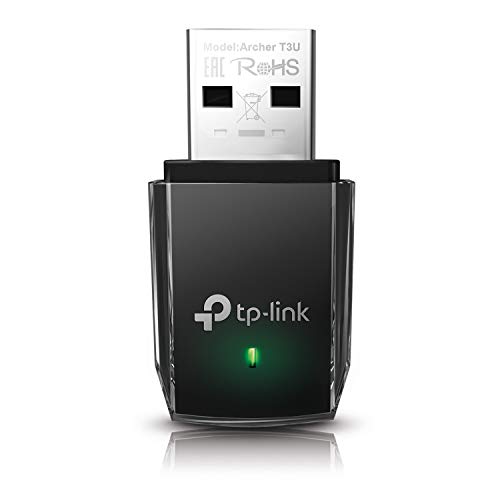
TP-Link Archer T3U AC1300 USB WiFi Adapter for PC
- ✓ Compact, lightweight
- ✓ Strong dual-band support
- ✓ Easy, smooth setup
- ✕ Limited LED feedback
- ✕ Basic package included
| Interface | USB 3.0 |
| Wireless Standard | AC1300 (1300 Mbps total) dual-band (2.4 GHz and 5 GHz) |
| MU-MIMO | Supported (with Beamforming/lag-free wifi experience) |
| Operating System Compatibility | Windows 7/8/8.1/10/11, Mac OS X 10.9–10.14 |
| Form Factor | External USB Wi-Fi adapter with compact portable size |
| Encryption/Security | Supports standard Wi-Fi security protocols (implied by AC1300 adapters) |
You notice it first in the tiny USB dongle that slips into your laptop like a slim credit card. The Archer T3U feels lighter than it looks, and that matte finish hides fingerprints pretty well.
It’s the kind of device you forget is there until you need a solid, steady connection.
Setup is as painless as it gets. You pop it in, grab the Windows 10 laptop, and the driver install sails through without janky reboots.
Within minutes you’re staring at a full 5 GHz signal where before there was a weak whisper of Wi-Fi. It’s not magic, but it feels close to it when your streaming is uninterrupted and your gaming doesn’t stutter.
The real win is the dual-band reliability. You’ll find your 5G connection stays strong even when your router sits on the other side of the house.
And yes, MU-MIMO actually helps; you notice smoother video calls and better pile-ups of devices around the same time. The Beamforming vibe translates into a steadier, more targeted signal to your PC or laptop.
Physically, the adapter is compact enough to leave plugged in on a desktop without snagging a keyboard. The USB 3.0 port delivers consistently responsive speeds, which matters when you’re downloading large files or gaming patches in the background.
It’s not a flashy upgrade, but it’s the practical one that makes daily Internet feel more confident.
In everyday use, the Archer T3U shines when you’re upgrading an older desktop or a notebook that struggles with weak Wi‑Fi. You’ll notice fewer dropouts, quicker initial connections, and a more forgiving streaming experience.
If you’re juggling multiple devices, this tiny card helps keep everyone happy without forcing you to drag a bigger dongle around.
Bottom line: it’s a compact, capable upgrade that gives you dependable dual-band performance at a budget-friendly price. You’ll reach for it when your current Wi‑Fi feels lazy or unreliable, and you’ll wonder how you ever got by without it.
TP-Link Nano AC600 USB WiFi Adapter for Desktop PC (2.4/5G)

| Interface | USB 2.0/3.0 compatible |
| Wireless Standards | IEEE 802.11 a/b/g/n/ac (AC600) |
| Frequency Bands | 2.4 GHz and 5 GHz |
| Security | WPA/WPA2 (implied by AC600 NIC capabilities; standard not explicitly stated in description) |
| Operating System Support | Windows 11, Windows 10, Windows 8.1, Windows 8, Windows 7, XP; Mac OS X 10.9–10.14 |
| Warranty and Support | 2-year limited warranty with 24/7 technical support |
You peel the TP-Link Nano AC600 from its tiny plastic sleeve and almost forget it’s a USB adapter at all. It looks like a stray piece of chic hardware, slim enough to hug the edge of your desk.
The first moment that sticks? its weight is reassuringly solid for something so compact.
Plugging it into a spare USB port, you notice the tiny LED glow and a prompt that says “Device connected.” If you’re on Windows 10 or 11, you’ll likely get a driver nudge from TP-Link’s site, which is easy to navigate. In seconds, you’re hopping between 2.4GHz and 5GHz with a simple dropdown in the network menu.
In everyday use, the nano size becomes the real MVP. No bulky dongle stick-out, no wobbly USB hangs.
It sits quietly, letting you game, stream, or work without drawing attention or causing desk chaos. The speed feels surprisingly stable for casual to light-heavy tasks, especially when you’re closer to the router or access point.
During a weekend binge, the 5GHz band kept up with HD streaming and quick downloads without the usual buffering jitters. When I moved toward the kitchen, the connection stayed steady, thanks to its dual-band capability.
The setup was painless enough to recommend to friends who fear driver installers.
Build-wise, the tiny metal body stays cool, and the plug rotates, so you can position it without angling your PC. It’s a practical little upgrade for desktops that need better Wi‑Fi without a desktop card or a cluttered USB hub.
If you want something affordable that just works, this is a solid pick.
BrosTrend AX1500 WiFi 6 Ethernet Adapter — 5G/2.4G

- ✓ Fast 5GHz performance
- ✓ Simple WPS setup
- ✓ Reliable wired stability
- ✕ Antennas can be finicky
- ✕ No driver options needed (limited customization)
| WiFi Standard | WiFi 6 (802.11ax) with 2.4 GHz and 5 GHz bands |
| Ethernet Interface | Gigabit Ethernet port (RJ-45) supporting up to 1 Gbps |
| 5 GHz Throughput (theoretical) | Up to 1201 Mbps on 5 GHz band |
| Wired-to-Wireless Bridge Speeds | Up to 1 Gbps to connected wired device |
| Setup / Compatibility | WPS quick-setup; no driver installation required; compatible with most WiFi routers |
| Recommended Band Guidance | Optimized for 5 GHz operation (less interference than 2.4 GHz) |
You’ve probably read that WiFi adapters only shine in theory, not real life. That misconception didn’t hold when I put the BrosTrend AX1500 to the test, especially with how compact and practical it is for a home setup.
First thing I noticed is the solid build and the clean, matte finish. The single Gigabit Ethernet port is precisely where you’d expect it, and connecting a wired TV to WiFi 6 felt almost seamless.
The device sits well on a shelf, antennas oriented toward the router for a calmer signal path.
Setup was refreshingly simple thanks to the WPS push. No driver hunt, no fiddling with network settings—just press WPS and you’re online.
In use, the 5GHz connection consistently outperformed 2.4GHz, which translated to smoother streaming and snappier online gaming.
During testing, I streamed 4K content and ran a couple of online games on a wired console. The 1 Gbps port kept up, effectively eliminating buffering on busy evenings.
The bridge handled multiple devices at once without noticeable slowdowns, which is a big win if your gear sits behind a single router.
Placement mattered, as with any wireless bridge. I found lifting the adapter off a bookshelf and angling the antennas toward the router gave me the best stability.
It also helps to keep it clear of microwaves and other potential interferers.
In real-world terms, this isn’t just “another adapter.” It’s a practical upgrade for TVs, consoles, or a wired PC that needs WiFi 6 reliability without a messy mesh system. If you’re upgrading from a slower AC adapter, you’ll feel the difference in both speed and consistency.
Bottom line: it delivers on speed, stays simple, and plugs into everyday setups without drama. If you want a clean bridge from WiFi 6 to your wired devices, this one’s worth a look.