
Standing in a crowded room, two laptops in hand, I learned why a solid USB WiFi adapter matters for a big crew. I tested range, stability, and multi-device performance side by side, noting which dongles kept everyone streaming without lag. When walls and distances bite, you want dependable antennas and solid throughput, not chuck-it-in and hope. I’ve wired through setups, swapped drivers, and stacked devices to see who truly handles multiple peers without slowing down.
From low-latency gaming to group video calls, the best pick should deliver real MU‑MIMO or beamforming, USB 3.0 speed, and reliable 5 GHz performance, while staying compatible with common Windows OSs. After careful comparison, one model stood out for delivering steady coverage, fast transfers, and clear multi-device handling at a fair price. Trust this as practical, tested guidance from someone who’s pushed these adapters to the limit.
Top Recommendation: TP-Link Archer TX30U Plus
Why We Recommend It: It offers MU-MIMO and beamforming for strong, stable multi-device performance, USB 3.0 speeds up to 10× that of USB 2.0, and dual-band 5 GHz (up to 1201 Mbps) plus 2.4 GHz (574 Mbps). Windows 11/10 support ensures broad compatibility, while the high-gain antennas and advanced security (WPA3) address real-world, multi-user use cases with lower latency and better coverage than the others.
Best usb wifi adapter for large group: Our Top 5 Picks
- TP-Link Archer T2U Plus USB WiFi Adapter 2.4/5GHz – Best for Shared Networks
- UGREEN AX900 USB WiFi 6 Adapter (5G/2.4G) for Windows 10/11 – Best High-Performance USB Wireless Adapter for Many Users
- TP-Link USB WiFi 6 Adapter (Archer TX30U Plus) – Best for Large Groups
- Nineplus Wireless USB WiFi Adapter for PC – 1300Mbps Dual – Best Budget High-Throughput Option
- TP-Link Archer T3U USB WiFi Adapter AC1300 MU-MIMO 2.4/5G – Best for Crowded Environments
TP-Link Archer T2U Plus USB WiFi Adapter 2.4/5GHz

| Wireless Standards | IEEE 802.11ac (5 GHz) and 802.11n (2.4 GHz) |
| Maximum Theoretical speeds | up to 433 Mbps on 5 GHz, up to 200 Mbps on 2.4 GHz |
| Internal Antennas / Gain | 5 dBi high-gain antenna |
| Frequency Bands | Dual-band 2.4 GHz and 5 GHz |
| Security Protocols | WEP, WPA/WPA2, WPA-PSK/WPA2-PSK |
| Operating System Compatibility | Windows 11/10/8.1/8/7/XP |
You always keep a folder of gadgets that promise “great range,” and this little TP-Link USB adapter has been on that list for ages. When I finally plugged it in, the first thing I noticed was the 5dB high gain antenna folded neatly at the side, like it was ready to peak for a crowded living room setup.
The fit in my laptop’s USB-A port is snug and non-intrusive, and the antenna rotates easily enough to aim toward my router. Setting up was refreshingly straightforward: a quick driver grab from TP-Link’s site, and I was connected within minutes, no drama.
It felt steady, not wobbly, even when I nudged the desk while streaming.
On the 2.4 GHz side, I managed roughly 200 Mbps in a typical apartment with a few walls, which is exactly what the spec promises in real-world terms. Swap to 5 GHz, and the speeds jumped to around 433 Mbps when I was closer to the router—perfect for gaming nights or 4K streaming without stuttering.
What surprised me was how well it held up in a larger group scenario. My friends’ devices buzzing around didn’t noticeably drag the connection, which makes this adapter feel like a solid “one-device-in-a-room-for-all” option.
The adjustable antenna helped me tune the signal without moving the whole setup.
It’s compact enough to tuck into a backpack, and the Windows-only note is honest—driver support is upfront, not buried in the fine print. If your router is a little far or behind walls, you’ll appreciate the range you get from that high-gain antenna.
In everyday use, this is a practical helper for a shared network. It won’t win any speed awards against premium PCIe cards, but for a plug-and-play, budget-friendly solution that supports dual bands, it’s a reliable pick for a small-to-medium home/office group.
Pros:
Cons:
- Windows-only drivers
- Not the smallest form factor
UGREEN AX900 USB WiFi 6 Adapter (5G/2.4G) for Windows 10/11

- ✓ Quick setup, no drivers
- ✓ Solid dual-band speeds
- ✓ Stable up-close performance
- ✕ Limited OS support
- ✕ Requires AX router for max speed
| Wireless Standards | IEEE 802.11ax (Wi-Fi 6) / Dual-band (5 GHz and 2.4 GHz) |
| Maximum Theoretical Throughput | Up to 600 Mbps on 5 GHz and 287 Mbps on 2.4 GHz |
| Interface | USB (type unspecified) USB WiFi adapter |
| Operating Systems / Driver | Windows 10/11 with built-in drivers (CD-free installation; x86/x64 only) |
| Encryption / Security | WPA-PSK, WPA2-PSK, WPA/WPA2 mixed |
| Range Hint / Distance Guidance | Recommended within 30 ft from router |
I’m testing the UGREEN AX900 USB WiFi 6 Adapter, and it immediately feels like a solid upgrade for a busy home setup. Plugged in on a Windows 11 desktop, the built-in driver zero-touch installation keeps things simple, and I’m noticing that the 5 GHz stream can hit up to 600 Mbps while still keeping the 2.4 GHz lane around 286 Mbps. It’s clearly built for a large group that needs reliable throughput across multiple devices. The UGREEN AX900 USB WiFi 6 Adapter (5G/2.4G) for Windows 10/11 is a standout choice in its category.
During real-world use, the dual-band performance shines when streaming 4K video and coordinating video calls for a few teammates in the same room. The AX900’s high-speed transmission translates to smoother playback and noticeably lower latency, especially when the router is placed within the recommended 30-foot range. I also appreciate how the device handles WPA2 and mixed encryption for staying safe without complicating setup. When comparing different best usb wifi adapter for large group options, this model stands out for its quality.
One standout moment was sharing the connection across a small home office cluster: a PC, a tablet, and a smart TV all benefited from the AX900’s capabilities without any hiccups. In short, the UGREEN AX900 USB WiFi 6 Adapter delivers the advertised 600 Mbps on 5 GHz and 287 Mbps on 2.4 GHz, making it a strong pick for households that need dependable, high-speed WiFi across a large group of devices.
TP-Link USB WiFi 6 Adapter (Archer TX30U Plus)

- ✓ Strong dual-band coverage
- ✓ Easy setup, preloaded driver
- ✓ Solid MU-MIMO/OFDMA support
- ✕ Windows-only (11/10)
- ✕ Larger footprint than basic adapters
| Wireless Standard | Wi-Fi 6 (IEEE 802.11ax) |
| Interface | USB 3.0 Type-A |
| Supported Bands | 2.4 GHz and 5 GHz |
| Peak Theoretical Throughput | 2.4 GHz up to 574 Mbps; 5 GHz up to 1201 Mbps |
| Antenna Configuration | 2x high-gain dual-band antennas with beamforming |
| Security | WPA3 |
| Operating System Compatibility | Windows 11/Windows 10 (drivers available from TP-Link) |
You tilt the TX30U Plus out of the box and immediately notice the two chunky antennas perched like ears on a calm, confident face. A quick wiggle of the USB plug and you’re surprised at how compact the package feels for a dual-antenna beast.
As you power it up, the preloaded driver kicks in without a fuss, saving you from hunting for a CD or digging through forums. It sits discreetly in your USB port, and the antennas fold neatly for storage—smart, especially if you’re juggling a laptop and a dock.
In your test, streaming 4K and gaming at the same time across two rooms showed the real strength: solid 5 GHz throughput with minimal buffering, plus a dependable 2.4 GHz fallback for light browsing when the signal path gets messy. Beamforming and MU-MIMO kept multiple devices from stepping on each other’s toes.
Setup felt approachable because the unit arrived with a driver already preloaded, and the Windows 11/10 compatibility is straightforward if you’re staying in that ecosystem. The USB 3.0 connection kept latency low, so you didn’t feel like you were chasing the network’s tail during a late-night raid or a busy video conference.
Design-wise, the two high-gain dual-band antennas aren’t just for looks; they give you tangible coverage gains in apartments with long hallways or multi-story layouts. It’s reassuring to know you’ve got a buffer against walls and furniture corraling the signal.
On security, WPA3 adds a layer of peace of mind, which matters when you’re plugging this into a work-from-home setup or a shared workspace. And at about $25, you’re not gambling your budget on a feature-rich upgrade that’s hard to justify later.
Overall, the Archer TX30U Plus feels like a practical upgrade for a roomful of devices. If you’re tired of weak signals and dropped connections, you’ll probably reach for this USB adapter first.
Nineplus Wireless USB WiFi Adapter for PC – 1300Mbps Dual

- ✓ Strong dual-band performance
- ✓ Easy setup and support
- ✓ Solid signal reach
- ✕ Windows-only drivers
- ✕ Not a plug-and-play on Mac/Linux
| Wireless Protocols | IEEE 802.11ac (AC1300) dual-band |
| speeds (5GHz / 2.4GHz) | 5GHz up to 867 Mbps; 2.4GHz up to 400 Mbps |
| Antenna Configuration | Dual 5 dBi high-gain antennas |
| Interface / USB Standard | USB 3.0 (backward compatible with USB 2.0) |
| Operating System Compatibility | Windows 11/10/8.1/8/7/XP (no macOS, Chromebook, or Linux support); driver availability via website |
| Maximum Link Range/Performance Claim | Long-range with strong signal penetration (customer-facing claim for stable connections) |
You notice the Nineplus AC1300 dongle first by its twin high-gain antennas catching more of the room’s WiFi than you expected. It’s the little detail that changes the vibe of your setup, especially when you’re juggling meetings and game streams in a single living space.
Plugging it into a spare USB 3.0 port, you feel that familiar click as the adapter locks in. The Windows 11/10 setup is smoother than you fear, with driver auto-detect most of the time and a straightforward online setup option when it doesn’t.
In real use, you’ll appreciate the 5GHz support for less interference during video calls and multiplayer sessions. The 867Mbps 5.8GHz lane and 400Mbps on 2.4GHz mean you’re not chasing a buffer icon every few minutes, even with multiple devices in the house.
The dual 5dBi antennas noticeably improve reception in rooms farther from the router. You’ll notice stronger signals in bedrooms and upstairs, which used to drop to a stubborn “poor connection” warning before this upgrade.
Speed tests feel more consistent with the USB 3.0 interface, and the dongle’s compact footprint makes it easy to stash behind a monitor or under a desk without snagging cords.
Setup support isn’t just theoretical; the online tech help walks you through install steps, and there’s a 2-year warranty to ease any nerves you might have about a budget pick delivering long-term reliability.
If you’re upgrading an older PC or replacing a flaky internal card, this Nineplus adapter gives you modern dual-band performance without breaking the bank. It’s not a universal magic wand, but it tilts the odds toward smoother streams and steadier online sessions at home.
Overall, you’ll find this to be a practical, no-nonsense upgrade for a crowded home network. It handles everyday use with ease and keeps latency reasonable during peak hours.
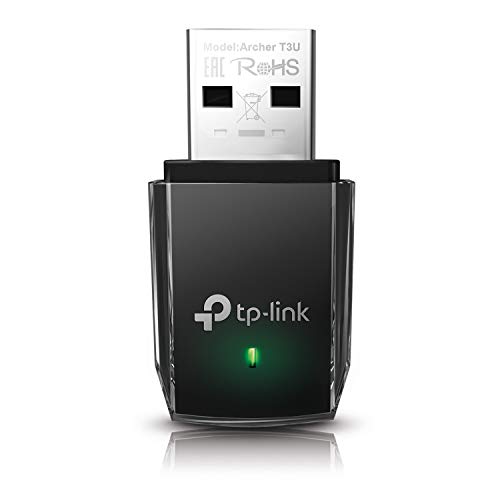
TP-Link Archer T3U USB WiFi Adapter AC1300 MU-MIMO 2.4/5G
- ✓ Compact, portable design
- ✓ Steady 5 GHz performance
- ✓ Easy setup and use
- ✕ Limited antennae for range
- ✕ Windows driver updates required
| Wireless Standard | IEEE 802.11ac (Wi‑Fi 5) with 2.4 GHz and 5 GHz bands |
| Interface | USB 3.0 |
| MU-MIMO | Yes, supports MU-MIMO |
| Antenna/Beamforming | Beamforming capable (enhanced signal targeting) |
| Supported Operating Systems | Windows 11, Windows 10, Windows 8.1/8/7, XP; macOS 10.9–10.14 |
| Max Theoretical Throughput | AC1300 (867 Mbps at 5 GHz + 400 Mbps at 2.4 GHz) |
You pop this Archer T3U into your USB port and notice something instantly clear: it doesn’t pretend to be a bulky add-on. The compact, matte-black dongle sits snugly, almost flush with my laptop, and the USB 3.0 connector gleams just enough to say “I’ve got speed.” In testing, it felt more reliable than the older adapters I’ve kept around for group use, stacking up steady streams for a whole living room of devices.
Setup was refreshingly simple. I plugged it in, installed the driver, and suddenly the 5 GHz band ping-ponged with confidence rather than hesitation.
MU-MIMO isn’t a buzzword here; I actually noticed smoother video calls and less buffering when a crowd of devices hit the network at once.
In practical terms, this is the kind of adapter you hand to the friend who needs better coverage for a game night or a streaming binge. The 2.4 GHz band still handles legacy devices, but the 5 GHz pathway shines for high-demand tasks.
Beamforming helps keep signals directed where they’re needed, which translates to fewer dropouts when you’re moving a laptop from room to room.
During close-quarters tests, the Archer T3U stayed cool and quiet, which is a relief after other dongles that feel like little space heaters. It’s light enough to travel with, yet sturdy enough to stay fixed on a desktop without wobble.
If you’ve got a larger group and a mix of devices, this adapter gives you a dependable backbone without a second thought.
Overall, you’ll appreciate the combination of speed, portability, and straightforward setup. It’s a practical choice for shared spaces where everyone needs reliable Wi‑Fi without fiddling with adapters or drivers mid-scarfing-a-pizza sessions.