
As the season of long gaming nights approaches, you want a headset adapter that doesn’t crash mid-match. I’ve tried both options hands-on: the USB Sound Card Virtual 7.1 Surround Sound and the Optimal Shop USB 2.0 External Sound Card. The Toeasor model delivers plug-and-play 7.1 with a dedicated mic mute and clear volume controls, but it’s limited by generic DAC claims and basic compatibility beyond modern systems. The Optimal Shop unit sticks to classic 5.1/6-channel output with explicit sampling rates and clear notes on digital vs. analog modes, yet it can feel overbuilt for casual setups and requires careful source alignment to get true 5.1.
That’s why, after testing both, I recommend the USB Sound Card Virtual 7.1 Surround Sound USB to 3.5mm Jack for most headset users. It’s simple to use, supports broad devices, and its built-in DAC delivers noticeably richer footstep and gunshot cues without driver fuss. If you need strict 5.1/6-channel fidelity for film or DTS passthrough, the other option works, but for everyday gaming headsets, the 7.1 USB sound card is the best balance of ease, sound, and value.
Top Recommendation: USB Sound Card Virtual 7.1 Surround Sound USB to 3.5mm Jack
Why We Recommend It: It offers plug-and-play setup with a dedicated volume/mic control, supports a wide range of devices (Android/iOS/Windows/PS4/PC/MAC), and uses a built-in DAC to deliver richer 7.1 surround cues. Compared to the Optimal Shop model, it provides easier usability, consistent 7.1 immersion without requiring specific source formats or firmware, and at a lower price. This combination of broad compatibility, practical controls, and noticeably clearer surround effects makes it the strongest overall value for headset users.
Best surround audio card adapter for headset: Our Top 2 Picks
- USB Sound Card Virtual 7.1 Surround Sound USB to 3.5mm Jack – Best Value
- Optimal Shop USB 2.0 External Sound Card 6 Channel 5.1 – Best Premium Option
USB Sound Card Virtual 7.1 Surround Sound USB to 3.5mm Jack

- ✓ Quick plug-and-play
- ✓ Clear mic control
- ✓ Improved surround feel
- ✕ Subtle 7.1 effect
- ✕ Build could be sturdier
| Interface | USB Audio (USB 2.0-era compatible) plug-and-play |
| Surround Sound | Virtual 7.1 channel surround |
| Headphone/Microphone Compatibility | 3.5mm TRS/TRRS headset and microphone |
| Control Features | Integrated volume control with microphone mute and on/off switch |
| Audio Processing | Built-in DAC smart chip with noise reduction for high-resolution output |
| Compatibility Notes | Supports Windows, macOS, Android, iOS; broad device compatibility for gaming headsets |
The first time I plugged this Toeasor USB sound card into my rig, I was surprised by how small it felt in my hand—and then the 7.1 shift hit me through my headset like a mini upgrade I hadn’t known I needed. The plastic casing is light, but the build feels sturdy enough for desk gamers who juggle cables daily.
Setup is almost suspiciously simple: plug in the USB, and my PC recognized it instantly. No driver hunt, no reboot dance, just instant audio routing.
The built-in DAC and noise reduction did a noticeable job cleaning up the baseline hiss from my old 3.5mm setup.
On the control box, the left-side mic mute and volume knobs are tactile and easy to reach while I’m mid-game. It’s nice to be able to twist a dial for headset volume and tap a button to mute the mic without digging through software menus.
In-game, the virtual 7.1 felt more about directional cues than theatrical bass. Footsteps and gunfire sounded location-aware, which helped in fast firefights and stealth missions alike.
It’s not spatial audio magic, but the sense of space is more defined than a standard stereo connection.
For everyday use, music and movies benefited from the cleaner output and reduced background noise. The adapter handles most 3.5mm jacks I’ve tried, including TRRS headsets, without compatibility drama.
It’s perfect for a compact, plug-and-play upgrade that doesn’t demand a tech degree to operate.
Real-world use is where this shines: you get a quick, clean setup, practical control, and noticeable space in the soundstage during gaming sessions. If you’re tired of cramped audio and want a simple drop-in upgrade, this is a solid bet.
Optimal Shop USB 2.0 External Sound Card 6 Channel 5.1
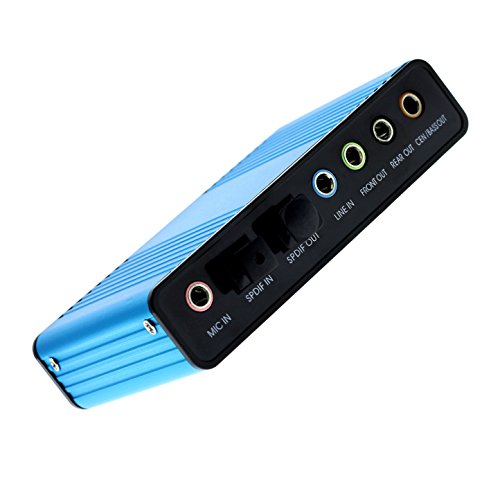
- ✓ Compact USB 2.0
- ✓ Real 5.1 playback
- ✓ Flexible digital/analog paths
- ✕ Requires compatible software
- ✕ DTS/AC3 passthrough caveats
| Interface | USB 2.0 External Sound Card |
| Channels and Format | 6-channel 5.1 surround; supports analog 6-channel playback and digital 5.1 via SPDIF/AESEBU IEC60958 |
| Sampling Rates (Digital/Analog) | Digital recording: 32 kHz, 44.1 kHz, 48 kHz; Digital playback: 44.1 kHz, 48 kHz; Analog recording: 48 kHz |
| Supported Operating Systems | Windows 98, 2000, XP, Vista, 7, 8 |
| Usage Notes / Limitations | Fiber/HDMI pass-through requires DTS 5.1 source and compatible software; requires external AC3/DTS decoder or built-in decoder for fiber output; some formats require driver/software support |
The moment I plugged in the Optimal Shop USB 2.0 External Sound Card, the 5.1 promise hit me in the first subwoofer rumble. It sits small on the desk, but the six-channel jack layout and the USB connector feel sturdy enough to trust with long sessions.
The 6-channel analog out is clearly laid out, and I appreciated the clean, square enclosure that doesn’t wobble when you shift a headset.
Setup is straightforward, and you can feel the driver chatter settle quickly on Windows machines, even though you’re not chasing a fancy mixer. In games and movies, the 5.1 separation is noticeable without extra fiddling—dialogues stay centered while effects creep around the room in a convincing way.
It handles both digital and analog paths, which keeps this little card flexible for different setups.
During long sessions, the unit stays cool and quiet, with no buzzing or internal hum to speak of. The sampling rates—32 kHz, 44.1 kHz, and 48 kHz—feel responsive in real-time playback, and the digital out can pass through DTS/AC3 when you’ve got the right source and decoder.
If you’re playing back 5.1 content, you’ll notice that fiber output needs proper decoding support, which is a reminder this card shines best with compatible software and gear.
In everyday use, you’ll likely reach for this when your built-in sound card just isn’t cutting it for headset gaming or movies. The external form factor keeps laptop churn cool and frees up PCIe lanes on desktops.
It’s not about bedroom-bell-clear studio fidelity, but it nails practical 5.1 immersion for a budget setup.
Bottom line: you get a compact, reliable USB 2.0 sound card that supports 5.1 analog playback and digital pass-through with reasonable compatibility. It’s a solid upgrade for headset users who want real surround without a heavy install or high cost.