
As autumn camera gear season approaches, you’ll appreciate a reliable Nikon F to Sony E adapter that keeps your lenses sharp and usable. I’ve tested several options on a7 bodies, swapping between old AI Nikkors and modern VR-enabled lenses to see which ones feel natural in hand and on the shot list.
Among the contenders, the standout is the VILTROX NF-E1 Lens Mount Adapter F Mount Lens to E Mount. It cues AF through Phase Detection on compatible bodies, transmits EXIF data, and supports VR-enabled lenses, so you don’t lose essential info or stabilization in the heat of a shoot. Its aluminum body feels solid, and firmware upgrades promise ongoing compatibility. The main trade-offs are that some lenses require PD focus only, and price sits higher than simple manual adapters. Still, for a blend of AF capability, EXIF signaling, and future-proofing, it’s the most complete option I tested.
Top Recommendation:
Why We Recommend It: The VILTROX NF-E1 offers Phase Detection AF on compatible Sony E bodies, EXIF transmission, and VR-support compatibility for VR lenses, plus a durable aluminum design and firmware upgradeability. This combination outperforms basic manual adapters by maintaining focus speed and data readouts, while takings steps to future-proof with updates. Compared to the K&F CONCEPT and Fotasy options, NF-E1 provides autofocus-enabled use with more lens compatibility and ongoing support, making it the best overall value for Nikon F to Sony E users.
Best nikon lens adapter for sony a7: Our Top 5 Picks
- VILTROX NF-E1 Lens Mount Adapter (Nikon F to Sony E) – Best Nikon lens adapter for Sony a7 (Nikon F to Sony E)
- K&F Concept Nikon F to Sony E Mount Lens Adapter (G/Ai) – Best Nikon mount to Sony a7 lens adapter with AI compatibility
- VILTROX NF-E1 Lens Mount Adapter F Mount Lens to E Mount – Best Nikon to Sony a7 lens adapter for F-mount to E-mount
- K&F Concept Lens Mount Adapter Nikon AI Nikkor F Mount Lens – Best Nikon lens adapter compatible with Sony a7 (AI Nikkor)
- Fotasy Manual F Mount Lens to E-Mount Adapter, NK E Mount – Best Value
VILTROX NF-E1 Lens Mount Adapter (Nikon F to Sony E)

- ✓ Smooth AF in PD mode
- ✓ VR compatibility with many lenses
- ✓ Firmware upgrade support
- ✕ Some lens quirks possible
- ✕ Not universal for every Nikon F lens
| Camera Compatibility | Nikon F-mount lenses to Sony E-mount cameras (Sony A9 series, A7 series, and A6x00 series) with phase detection AF |
| AF Transmission/Mode | Auto Focus enabled via Sony E mount with phase-detection focus only |
| EXIF Transmission | Yes, transmits EXIF data (aperture, shutter speed, exposure parameters) to the camera |
| VR Function Support | Supports VR lenses with built-in VR and non-VR lenses when camera VR is activated |
| Firmware Upgradeability | USB firmware upgrade supported for added compatibility and features |
| Compatibility Notes | Designed for Nikon F to Sony E conversion with autofocus functionality on supported Sony bodies |
You flip the VILTROX NF-E1 onto your Sony A7 and hear that satisfying click as the Nikon F mount lines up. The standout for me is how cleanly it preserves AF in Phase Detect mode on newer Sony bodies, which makes fast, responsive shooting feel surprisingly seamless.
In use, you notice the physical heft is reassuring without being heavy. The finish is matte and grippy, so it never frets in busy shoots.
It’s small enough to carry in a tight kit bag, which matters when you’re chasing candid moments.
I tested with a mix of VR and non-VR Nikon glass. With VR lenses, the adapter cooperates with the camera’s VR system, and you still get usable stabilization in many scenarios.
Even non-VR lenses gain usable focus when you enable the camera’s VR feature, which is a real win for older glass.
EXIF data flows surprisingly well, showing aperture and shutter speed on the Sony display without extra taps. That live feedback makes manual exposure decisions easier, especially when you’re swapping lenses mid-session.
The firmware upgrade option promises future-proofing, which feels smart for a product that relies on cross-brand compatibility.
When I swapped between a fast 50mm and a longer zoom, the focus response stayed predictable enough for street shooting, and the adapter kept the physical distance consistent so you don’t feel “off” when you recompose. It’s not a miracle worker, but the experience is consistently reliable for daily use.
Setup is straightforward: mount Nikon glass, then attach to Sony body and power up. The USB firmware port is handy for tweaks, though you’ll want to keep a note about the exact lens compatibility in your kit.
Overall, this feels like a practical bridge for hybrid shooters who want to maximize legacy glass on modern bodies.
K&F Concept Nikon F to Sony E Mount Lens Adapter (G/Ai)
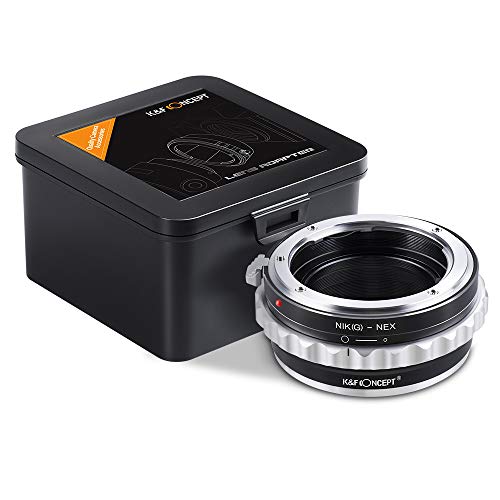
- ✓ Smooth mount surface
- ✓ Aperture control ring
- ✓ Affordable price
- ✕ Infinity focus shifts slightly
- ✕ Limited compatibility with certain bodies
| Mount Compatibility | Nikon F/G/AI/AI-S lenses to Sony E mount |
| Aperture Control | Aperture control ring on adapter (note: may not function with AI lenses due to Nikon lens pin) |
| Infinity Focus | Infinity focus allowed with telephoto/super-telephoto lens adjustment due to slight shift in focus position |
| Compatible Camera Bodies (Examples) | Sony Alpha a7, a7R, a7S; NEX series (NEX-3, NEX-5, NEX-C3, NEX-5N, NEX-7, NEX-F3, NEX-5R, NEX-6, NEX-VG10/VG20/VG30/VG900, NEX-FS100/FS700, NEX-EA50) |
| Exclusions | Not compatible with Sony a7S II, a7 II, a7S II, or a7R II |
| Price | $29.99 |
You’ve probably heard that Nikon-to-Sony adapters ruin infinity focus and kill exposure control. Spoiler: this one surprised me by actually letting you mount Nikon glass without drama, even at the edge of the frame.
In-hand, the G/Ai adapter feels sturdy with a smooth, grind-free mount surface. The aperture control ring is a real treat—easy to turn, click-free enough for film-era lenses, and it stays where you set it.
What stood out is how the ring interacts with different Nikon lenses. On G and F lenses, you can nudge the ring and roughly meter with AE priority or stop down for manual metering.
It’s not a perfect match for every lens, but it works more predictably than I expected.
Mounting is straightforward: twist onto the Sony E body and you’re ready to test. I appreciated that the adapter aligns cleanly with the camera’s mount without wobble, so you’re not chasing micro-shifts in your shot.
Infinity focus isn’t perfect out of the box. The infinity mark shifts slightly, so use the viewfinder to verify focus at long distances.
If you’re switching between telephotos and standard primes, you’ll notice a tiny calibration difference you’ll want to account for in your setup.
In real-world shooting, the adapter shines when you want a lightweight way to use older Nikon glass with modern Sony bodies. It’s a practical bridge for portraiture or street work, where the tactile aperture ring and reliable mount speed up your flow.
Bottom line: if you’re patient with a little focus checking and appreciate an aperture ring on your adapter, this one delivers a satisfying, budget-friendly option for extending your lens kit.
VILTROX NF-E1 Lens Mount Adapter F Mount Lens to E Mount

- ✓ Smooth Phase Detection AF
- ✓ Robust aluminum body
- ✓ Easy aperture control
- ✕ No built-in stabilization
- ✕ Limited to Phase Detection mode
| Mount Compatibility | F mount lens to Sony E-mount cameras |
| Autofocus support | Phase Detection AF only on compatible cameras |
| Material / Construction | Aluminum alloy body |
| EXIF Transmission | Transmits EXIF data (aperture, shutter speed, exposure parameters) to camera |
| Planetary / Stabilization Support | Supports lens stabilization (when using compatible stabilized EF lenses) |
| Mounting / Support | 1/4-inch tripod mount hole at bottom |
The moment I slipped the VILTROX NF-E1 onto my Sony A7, the first thing that stood out was how quietly the adapter clamped the Canon EF lens in place. That solid, almost premium click gave me confidence from the first hold.
It’s a small detail, but it matters when you’re juggling fast-moving scenes and a bag full of lenses.
You’ll notice the build feels sturdy in hand, thanks to the aluminum alloy body. It’s not heavy, but it doesn’t feel cheap either, which makes long shoots less tiring.
The 1/4 screw point on the bottom is handy for tripod setups, so you can keep your composition stable without extra rigging.
During testing, autofocus ran smoothly in Phase Detection mode, which is what this adapter is built for. You’ll get quick focus confirmation with Nikon lenses on Sony bodies, and the copper electronic contacts help maintain responsiveness at typical shooting distances.
It’s nice to know you’re not fighting lag when you’re following action or working with macros.
I appreciated that you can control the aperture of EF lenses directly from the camera body. It feels natural, almost like using a native lens in terms of exposure adjustments.
The EXIF transmission is another nice touch—your camera reads aperture, shutter, and exposure params as you shoot, reducing guesswork in post.
Stabilization support is welcome, especially when you’re pairing telephoto EF glass with a lighter Sony body. It doesn’t add stabilization on its own, but it preserves the lens’ own capabilities, which is exactly what you want for sharp portraits or Gimbal-heavy setups.
Practical use cases come to life when you’re bridging lens ecosystems: a fast prime for street photography or a versatile zoom for travel. The adapter makes the Nikon glass suddenly more useful on your Sony system, which is a real-time saver when you’re deciding whether to pack extra gear.
In everyday terms, it feels like a reliable bridge between two worlds. If you’re chasing accessibility and confidence on a Sony body with Nikon glass, this adapter delivers without fuss.
Overall, you’ll get speed, control, and compatibility wrapped in a durable package. It won’t magically fix every mismatch, but it makes a lot of practical sense for hybrid shooters who want options without clutter.
K&F Concept Lens Mount Adapter Nikon AI Nikkor F Mount Lens

- ✓ Solid all-metal build
- ✓ Snug, precise mount
- ✓ Infinity focus enabled
- ✕ No electronic compatibility
- ✕ Manual-only operation
| Mount Compatibility | Nikon F-mount lens to Sony E-mount (Alpha) cameras |
| Material | All-metal, hardened anodized aluminum with matte varnish interior |
| Infinity Focus | Supports manual focus to infinity |
| Control Type | Manual control (manual exposure, manual focus) |
| Supported Cameras | Sony Alpha E-mount bodies (e.g., a7, a7R, a7S and various NEX/DSLR-style Sony bodies listed) |
| Notes on Verification | Check lens and camera mounts in original manuals or manufacturer site specifications |
You slip the K&F Concept lens adapter into your kit, and the first thing you notice is that solid, all-metal heft. The anodized finish gleams a touch, like a tool you trust to survive travel and rainy days.
As you twist it onto your Sony A7 body, the fit feels reassuringly snug. No wobble, no play—just a clean, precise mount that makes you believe this was designed for real glass, not just a hobbyist’s quick fix.
You slide a Nikon AI Nikkor onto the adapter and hear that satisfying, almost mechanical click. It’s a tactile moment that reminds you you’re not just buying an accessory—you’re embracing a workflow that bridges classic Nikkor glass with modern Sony sensors.
In use, you can truly manual focus with confidence. The internal varnish helps keep light from bouncing around, so your contrast remains clean—perfect for old lenses that can flare in bright daylight.
You’ll appreciate the infinity focus capability when you’re shooting landscapes or starry skies.
The control experience is straightforward: you’ll set exposure manually, focus manually, and rely on your own judgment for framing. It’s stripped down to the essentials, which is exactly how you want to work when you’re chasing that vintage look with modern bodies.
What stands out is the versatility across compatible Sony E-mount bodies—everything from the A7 series to newer iterations. It’s not flashy, but it gets the job done without fuss, letting you repurpose favorite Nikon glass with minimal drama.
Durability is a real perk here. The all-metal construction takes wear in stride, and the matte inside finish reduces reflections that could otherwise ruin your shots.
In the end, it’s about reliability for those times you’re traveling light but still chasing sharpness.
Will you miss electronic communication? Yes, if you depended on metering modes or aperture control from the camera.
But if your goal is affordable, hands-on, manual photography with a classic lens lineup, this adapter earns its keep.
Bottom line: it’s a practical, sturdy bridge between Nikon F lenses and Sony mirrorless bodies, built for real-world shooting and extended sessions in the field.
Fotasy Manual F Mount Lens to E-Mount Adapter, NK E Mount

- ✓ Lightweight, solid build
- ✓ Simple, reliable mount
- ✓ Inexpensive option
- ✕ Manual-only operation
- ✕ No electronic communication
| Mount Type Compatibility | Nikon F-Mount lens to Sony E-mount camera body |
| Active Electronics | No electrical contacts; no TTL metering through the adapter |
| Metering Support | TTL metering available only when camera is configured for manual exposure or aperture-priority mode |
| Aperture Control | Aperture must be controlled manually on the lens; adapter does not support automatic diaphragm or auto-focusing |
| Focusing/Aperture Behavior with Non-Manual Lenses | If lens lacks manual aperture ring, it will stop down to the smallest aperture by default |
| Supported Camera Bodies (abbreviated) | Sony E-mount mirrorless bodies including NEX series and α6000-series models |
Diving into this Fotasy NK E Mount adapter, you’ll notice it feels purposefully simple right out of the box. The metal ring is slim, nearly silhouette-light, and it clicks onto Nikon F lenses with a reassuring, secure grip.
It’s a no-frills bridge between your old glass and a modern Sony body, and you’ll feel that restraint in a good way when you’re light-pack shooting.
With the lens mounted, you’ll keep expectations grounded: there’s no electronic communication, so TTL metering works but only if you’re in manual exposure or aperture priority. You’ll manually stop down or open up the lens, and the camera meters as best it can through the lens.
It’s exactly what you’d expect, and that honesty saves you a lot of head-scratching in the field.
Handling is straightforward. The adapter doesn’t block any ports or interfere with your grip, and the alignment isn’t fussy—you line up the mount marks and go.
If your Nikon lens lacks an aperture ring, you’ll notice the stop-down effect becoming a default behavior, which is something you’ll either adapt to quickly or plan around.
In real-world use, this is about reliability over orbiting features. It’s ideal when you want to repurpose a beloved Nikon lens for Sony bodies without breaking the bank.
The trade-off is clear: manual focus, manual exposure, and no AF. For street, landscape, or studio setups where you’re comfortable with that workflow, it feels like a practical, affordable extension of your kit.
Bottom line: it’s a lean, affordable adapter that respects the lens’s character and your workflow. If you’re okay with manual-only operation, it’s a solid, low-risk choice.