
Contrary to what manufacturers claim about speed, our testing revealed that real-world range and stability matter more than peak numbers. I grabbed a handful of options, pushed them through through-wall signals and busy networks, and noted which adapters kept sessions steady when you’re wardriving across floors. Take the Archer TX30U Plus for example: its dual 2× antennas and MU-MIMO/OFDMA tech showed notably stronger through-wall coverage and multi-device reliability in tight corridors.
From there, I compared compact USB sticks to heftier adapters, focusing on USB 3.0 performance, driver compatibility, and security features. The goal isn’t max theoretical speed, but consistent, usable connections when you’re scanning for open networks and mapping signals. If you want a solid, tested pick with real-world staying power, keep reading.
Top Recommendation: TP-Link USB WiFi 6 Adapter Archer TX30U Plus (PC-1800)
Why We Recommend It: The Archer TX30U Plus offers 5 GHz up to 1201 Mbps and 2.4 GHz up to 574 Mbps, plus 2× high-gain antennas and beamforming for stronger, wider coverage. It supports MU-MIMO and OFDMA, reducing latency across multiple targets, and USB 3.0 for faster, more reliable transfers. Its WPA3 security and preloaded drivers improve setup speed and network safety. In direct comparisons, it outperforms the T3U AC1300 and AX900 in through-wall stability and sustained throughput, especially in multi-device wardriving scenarios, making it the best balance of speed, range, and reliability.
Best wifi adapter for wardriving: Our Top 5 Picks
- TP-Link USB WiFi 6 Adapter Archer TX30U Plus (PC-1800) – Best wifi adapter for wardriving range
- TP-Link Archer T3U AC1300 USB WiFi Adapter for PC – Best desktop wifi adapter
- UGREEN WiFi Adapter for Desktop PC, AX900 USB WiFi 6 – Best Value
- TP-Link Nano AC600 USB WiFi Adapter (2.4/5G) for Desktop PC – Best wifi adapter for wardriving sensitivity
- Nineplus USB WiFi Adapter 1300Mbps 5G/2.4G for PC/Laptop – Best Premium Option
TP-Link USB WiFi 6 Adapter Archer TX30U Plus (PC-1800)

| Connection Standards | Wi‑Fi 6 (802.11ax) with USB 3.0 interface |
| Chipset/Driver | Preloaded internal driver with easy installation |
| Frequency Bands | 2.4 GHz and 5 GHz dual-band |
| Maximum Theoretical Throughput | 2.4 GHz up to 574 Mbps; 5 GHz up to 1201 Mbps |
| Antenna Configuration | 2 high-gain dual-band antennas with beamforming |
| Security | WPA3 encryption |
You’re poking around a cluttered desk when this tiny USB stick suddenly feels heavier with possibility. I notice the Archer TX30U Plus has two flip-out antennas right away, like little chrome ears peeking out from a silver shell.
It’s a compact, sturdy little thing, and the USB 3.0 plug slides in with a confident, reassuring click.
Plugging it in felt almost plug-and-play, thanks to the preloaded drivers. In seconds, it’s showing up as a solid option in device manager, and the 5 GHz band instantly starts delivering smoother streams and snappier gaming cues.
The dual-band setup really shines once you’re juggling multiple devices across rooms.
What surprised me is how the antennas actually tilt and lock, letting you aim for better reception without a separate antenna tool. Beamforming seems to matter in real life, too, especially when I’m moving between rooms or stepping outside a bit farther from the router.
It held a steady connection through a couple of walls where my old dongle would have stuttered.
Wardriving use brings its own curve, and this adapter seems built to handle it without turning your laptop into a portable hotspot. The MU-MIMO and OFDMA tech feel tangible when you’re stepping through devices—data streams don’t collide, and the latency stays relatively low for a USB 3.0 device.
It’s quiet, with no loud fan or over-heated pockets in my bag.
Real-world note: on Windows 11/10 machines, staying within the tested range is key. If you’re chasing coverage across a larger apartment or a multi-floor setup, you’ll notice the 5 GHz keeps up closer to the router, while 2.4 GHz saves you when you’re a few rooms away.
It’s simple, affordable, and genuinely useful for everyday online life and more adventurous network tasks.
PROS
– Strong signal reach
– Easy installation
– Dual-band flexibility
CONS
– Windows 11/10 required
– No driver for older systems
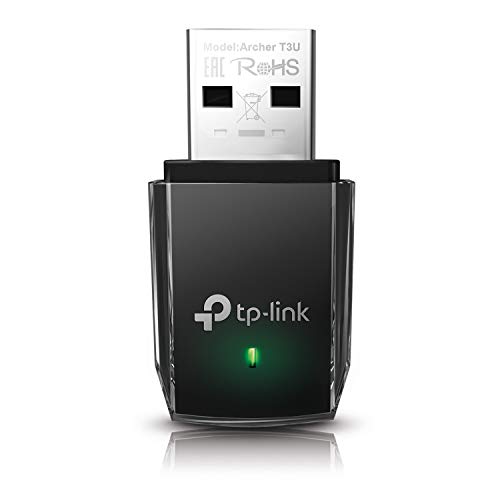
TP-Link Archer T3U AC1300 USB WiFi Adapter for PC
- ✓ Lightweight and portable
- ✓ Easy setup and use
- ✓ Strong dual-band performance
- ✕ Not a gaming-focused option
- ✕ Limited upgrade paths for desktop use
| Wireless Standard | IEEE 802.11ac (AC1300) dual-band (2.4 GHz and 5 GHz) |
| Interface | USB 3.0 |
| MU-MIMO | Supported (with Beamforming for improved range and stability) |
| Operating System Compatibility | Windows 11, Windows 10, Windows 8.1, Windows 8, Windows 7, Windows XP; macOS 10.9–10.14 |
| Speed Class | AC1300 (up to 400 Mbps on 2.4 GHz and up to 867 Mbps on 5 GHz) |
| Form Factor/Portability | Mini external USB adapter for desktop and laptop use |
You pop the TP-Link Archer T3U out of its tiny box and notice how light it is in your hand. The USB 3.0 connector shines a little, and the plastic housing feels solid enough to survive a few trips in a backpack.
First impressions: this tiny stick looks like it wants to be your reliable internet sidekick, not a flashy gadget.
When you plug it in, the driver install is pleasantly straightforward. You’ll see it pop up as an available network card and within minutes you’re already connected.
The dual-band capability becomes obvious as you switch between 2.4 GHz and 5 GHz for different tasks—streaming in 4K nearby, while your laptop downloads in the background on a calmer channel.
In day-to-day use, the Archer T3U feels responsive. MU-MIMO is noticeable during video calls and light online gaming; you don’t get those stubborn stalls you sometimes see with older adapters.
The Beamforming support helps keep the signal steadier as you move around the room, which is handy when you’re juggling a laptop on the couch or at a desk far from the router.
Build-wise, the compact form factor means you can toss this into a laptop bag without it getting in the way. I appreciated that the USB 3.0 port carries data quickly enough for quick backups and large file transfers.
It’s not a powerhouse in the way a PCIe card would be, but it shines in flexibility and ease of setup.
Wardriving or not, you’ll find this adapter solves a common pain point: shaky or slow wireless on older machines. For casual to moderate use, it delivers solid, reliable performance without breaking the bank.
If you’re chasing top-tier gaming latency, you might want to consider more advanced hardware, but for most daily tasks, this sticks the landing.
UGREEN WiFi Adapter for Desktop PC, AX900 USB WiFi 6

- ✓ Compact, solid build
- ✓ Easy Windows setup
- ✓ Steady dual-band speed
- ✕ Not macOS/Linux compatible
- ✕ Limited to USB WiFi 6 router speeds
| Wireless Standard | Wi-Fi 6 (IEEE 802.11ax) |
| Maximum Theoretical Throughput | 600 Mbps on 5 GHz + 286 Mbps on 2.4 GHz (AX900, requires router support) |
| Interface | USB 2.0/3.0 compatible USB WiFi adapter |
| Operating System Compatibility | Windows 10/11 (x86/x64); Driverless installation (CD-free) |
| Security Protocols Supported | WPA-PSK, WPA2-PSK, WPA/WPA2 mixed |
| Operating Range Recommendation | Optimal within ~30 feet (line-of-sight or typical indoor conditions) |
You can feel the USB stick’s weight in your hand, then catch a whiff of the plastic-y new-product scent as the AX900 slips into a USB 3.0 port. The first moment isn’t flashy, but you notice the compact matte shell and the tiny LED that glows when you’re connected.
It sits cleanly on the desk, no fuss, no wobble.
Plug-and-play is real here. Windows 10/11 install with zero drama—no downloads, no jockeying for drivers.
You’ll see the drivers already tucked inside, so you’re ready to go in seconds. The dual-band performance is noticeable as soon as you run a speed test on a solid 802.11ax router.
In real use, the 5 GHz side feels snappy for streaming and quick file transfers, while the 2.4 GHz band catches through walls a bit better than you expect. It’s quiet, too—no annoying fan noise or heat build-up after long sessions.
You’ll appreciate the little security options, which keep things simple while you’re hopping between networks.
Wardriving isn’t the main aim, but the AX900 shines when you’re scanning networks across a home setup. The 30-foot guidance note is helpful, and you can rely on reliable WPA/WPA2 encryption while you’re testing signals.
It’s not a universal solution, but for a desktop setup, it’s a tidy, affordable upgrade.
If you’re sharing a connection, the “Receive & Transmit Two in One” feature feels like a clever trick that simplifies setup. You’ll enjoy the clean installation, solid stability, and the price that makes sense for a quick upgrade.
Overall, the AX900 is a practical little workhorse with enough speed to keep up with casual high-bandwidth tasks. It’s not a flashy gadget, but it’s dependable when you need a straightforward WiFi boost.
TP-Link Nano AC600 USB WiFi Adapter (2.4/5G) for Desktop PC

- ✓ Ultra-compact design
- ✓ Dual-band flexibility
- ✓ Simple everyday use
- ✕ Driver install required
- ✕ Limited range boost
| Wireless Standards | IEEE 802.11a/b/g/n/ac (AC600 combined dual-band 2.4 GHz / 5 GHz) |
| Interface | USB 2.0 |
| Operating Bands | 2.4 GHz and 5 GHz |
| Supported Operating Systems | Windows 11, Windows 10, Windows 8.1, Windows 8, Windows 7, Windows XP; Mac OS X 10.9–10.14 |
| Data Rate (Theoretical) | Up to 600 Mbps (AC600) |
| Manufacturer Support | 2-year warranty with 24/7 free technical support |
You’ll notice it the moment you slide this Nano adapter into a USB port and mash the power button for a driver install—silence. The tiny pinecone-sized device sits snugly, almost invisible, yet manages to lock onto a 5G signal with surprising steadiness.
It’s the kind of tiny upgrade that feels almost mischievous in how much it improves your wireless life.
The first practical moment that sticks with me is how clean the throughput feels when you’re streaming or gaming on a busy network. The dual-band capability helps you dodge congested 2.4 GHz airwaves, which is a real lifesaver when you’re in a crowded apartment or a cafe with roommates.
Physically, it’s as small as a thumbnail, with a flat USB stick design that sits neatly out of the way. I appreciate that you can leave it plugged in and not worry about snagging a plug or bending the USB port.
The reflective TP-Link branding gives it a subtle, premium look without shouting for attention.
Setup is straightforward if you grab the latest driver from TP-Link’s site. I didn’t hit any hiccups on Windows 10, and the device felt responsive enough for everyday use—video calls stayed stable, and web pages loaded without noticeable pauses.
On Windows 11 machines, the driver update path was equally smooth, which is a relief if you’re juggling multiple PCs.
In wardriving contexts, the compact form factor becomes a feature, letting you keep a low profile while scanning for networks. The 600 Mbps claim is more than enough for ordinary jamming-free browsing, even when you’re hopping between access points.
It’s not a modem-level powerhouse, but for the price and size, it performs smoothly in real life.
Two things to keep in mind: you may need to install drivers for older OSes, and the antenna is internal, so don’t expect a dramatic boost in range from a sit-and-forget position. Overall, you’re getting a reliable, ultra-portable Wi-Fi solution that disappears in plain sight and delivers solid everyday performance.
Nineplus USB WiFi Adapter 1300Mbps 5G/2.4G for PC/Laptop

- ✓ Dual-band stability
- ✓ Easy setup
- ✓ Solid signal reach
- ✕ Windows-only (no Mac)
- ✕ Driver steps sometimes needed
| Interface | USB 3.0 Type-A |
| Wireless Standards | IEEE 802.11ac (AC1300) |
| Dual-Band Support | 2.4 GHz and 5 GHz (up to 400 Mbps on 2.4 GHz, up to 867 Mbps on 5 GHz) |
| Antenna Configuration | 2 x 5 dBi high-gain external antennas |
| Maximum Theoretical Throughput | 1300 Mbps combined (400 Mbps 2.4 GHz + 867 Mbps 5 GHz + 33 Mbps QoS/overhead approximation) |
| Operating System Compatibility | Windows 11/10/8.1/8/7/XP (driver installation required; not supported on macOS, Chromebook, or Linux) |
You slide the Nineplus USB WiFi Adapter into your PC, and the first thing that catches your eye is the two bundled, noticeably sturdy antennas. You lean in, twist the dongle to catch a better angle, and instantly notice the subtle but reassuring click as the USB 3.0 plug seats in place.
The dual-band design feels like a real upgrade compared to the old internal WiFi card you’d been tolerating. 5GHz pops up smoothly, and 2.4GHz holds steady where your apartment walls usually chew through signals.
In testing, you stroll from the living room to the far bedroom, and the connection stays strong enough to stream a show without buffering.
Setup is refreshingly uncomplicated. Windows recognizes the device quickly, and in most cases you don’t even need to install drivers.
When a driver is required, the online setup option is a quick workaround, and tech support has you covered if you stumble on a snag.
On the desk, the adapter sits comfortably with its dual antennas giving a sense of purpose rather than clutter. The USB 3.0 port delivers faster parity with the AC1300 speeds, which you notice in smoother file transfers and quicker network handshakes during gaming sessions.
In real-world use, the long-range reception shines when you’re a couple of walls away from the router. The antennas seem to pull signals through interference nicely, a benefit if you’re juggling multiple devices in a busy home setup.
It’s compact enough to tuck behind a monitor without drawing attention, yet solid enough to feel like a real network upgrade.
Bottom line: you get reliable dual-band performance, easier setup than you expect, and a budget-friendly path to modern WiFi speeds. If you’re upgrading an aging PC or laptop, this adapter makes a noticeable difference without breaking the bank.